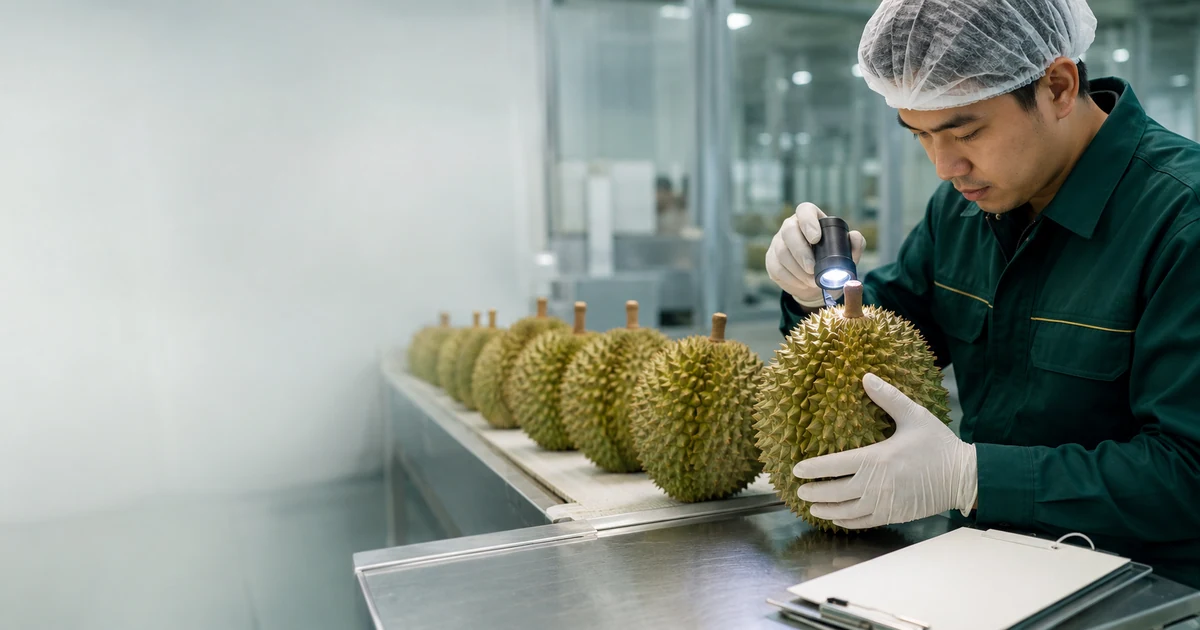
Durian seed borer: set a release gate before export
A guide to controlling seed borer risk in export durian, from orchard surveys, holding periods, screening and cut tests to lot segregation and release approval, with evidence that can be traced back.
By the DurianTradeX team · Updated · Reading time 11 minPrimary keyword: durian seed borer export
- Measures published by Thailand’s Department of Agriculture for southern export durian in late June 2026 require an advance orchard survey, holding after cutting and screening at the packhouse, for a total of at least 96 hours before certification inspection.
- Time alone does not make a lot risk-free. Farm, harvest, holding, inspection, packing and shipment IDs must be linked, together with screening results and hold or release status.
- When something abnormal is found, stop the affected scope, preserve evidence, trace back, and let an authorised person approve release. Never mix lots or edit data after the fact.
The short answer: make the 96-hour release gate a control system, not just a timer
For southern Thai durian for export, the “4-layer PLUS” measures published by the Department of Agriculture in late June 2026 require an orchard survey at least 7 days before harvest, holding fruit for at least 24 hours after cutting, and a further holding and screening period of at least 72 hours at the packhouse: at least 96 hours in total before certification inspection and the issue of a phytosanitary certificate. Businesses should build a release gate that checks time, lot identity, screening results, evidence and approver, and re-check the latest official notices or orders before applying it to the actual season, area, market and shipment.
- Start the clock from an evidenced event, not a time typed in afterwards.
- Separate lots by orchard, harvest date, holding point and risk status.
- Any lot with incomplete data goes on hold automatically.
- Passing the time requirement does not replace survey, screening or cut-test results.
- Record the version of the requirements and the date last checked.
Facts that must be confirmed
The figures of 7 days, 24 hours, 72 hours and 96 hours in this article refer to measures for southern export durian published in June 2026. Do not apply them as a permanent rule to every area or market without checking with the Department of Agriculture, local authorities and the destination country’s conditions.
What the gate must be able to answer
Before release, the system must show which orchard the durian came from, when it was harvested, where it was held, what checks it passed, who inspected it, whether any exceptions were found, and which cartons or pallets went into which shipment.
Why seed borer is a shipment-level risk
Thailand’s Department of Agricultural Extension explains that seed borer damages the inside of the fruit and may leave no clear sign on the outside, so surface inspection alone is not enough. An alert from the destination can affect far more than the fruit found, because the authorities must trace back to the orchard, packhouse, lot and certificates involved. The risk therefore covers plant health, export continuity, the cost of held goods and buyer confidence.
- Hidden defect: a normal exterior does not mean there is no risk inside.
- Lot contamination: mixing product widens the scope of investigation.
- Evidence gap: the start and end of the holding period are unknown.
- Traceability gap: you cannot trace back to the orchard or forward to the carton.
- Commercial impact: missed sailings, extra inspection, segregation or claims.
Do not draw conclusions from a single sample
Cut tests and sampling only provide information within the scope of the sampling plan. Those responsible must set the rationale, sample size, sampling positions, recording method and rules for abnormal findings, and never claim that one sample result guarantees a whole shipment.
Turn the measures into a verifiable timeline
Build a digital timeline from before harvest to the certificate application. Every event needs a lot code, time, operator, location and evidence, such as orchard survey records, photos where policy allows, delivery notes, holding positions, screening results and cut-test lists. If product is moved, lots are split or merged, or the shipment changes, open a new event; never adjust the original time so it appears to meet the requirement.
- T−7 days or earlier: survey the orchard and record its risk status under the applicable measures.
- Harvest event: create a harvest lot with orchard, plot, date and time and harvest team.
- Orchard holding: start and end of holding after cutting, with location and owner.
- Packhouse holding: receive, segregate, hold, screen and record results.
- Certification readiness: confirm duration, inspection results, traceability and exceptions before applying.
Use two event times
Record both the time the event actually happened and the time the user entered it in the system. If the gap exceeds a threshold, raise an alert and require a reason. This separates late data entry on the floor from backdating.
Never carry a countdown across lots
One lot’s holding time should not be transferred to a new lot created by mixing, changing scope or adding fruit, unless official rules and an approved procedure clearly allow it.
Design lot segregation so risk does not spread through the packhouse
The core of control is that fruit from different orchards, harvest dates or risk levels never loses its identity during holding and packing. Define areas, routes, status labels and movement permissions clearly. Use the statuses received, holding, screening, suspect, rejected, cleared and packed, and allow a status change only when the evidence is complete.
- Each harvest lot references a verified farm ID and block ID.
- Use labels or QR codes that stay readable in damp areas and during handling.
- Segregate suspect lots physically and in the system.
- Record splits and merges with parent–child relationships.
- Never move held product onto the packing line through a general override.
- Carry out line clearance before changing lot or risk level.
Set up a real quarantine zone
A holding area needs boundaries, capacity and an owner, not just a status on screen. When the area is full, the system should stop receiving or apply a relocation plan approved in advance, rather than mixing product and correcting the data later.
Build screening records that support decisions
Screening records must reflect what was actually done and link to the lot, stating the inspection plan, sampling points, number inspected, findings, inspector, time, equipment or method used and supporting evidence. For risky areas or lots, follow the inspection and cut-test levels the authorities require at the time; never invent a sampling rate and present it as an official requirement.
- Pre-harvest survey records and trap signals where traps are used.
- Receiving inspection and fruit condition on arrival at the packhouse.
- Holding observations at the set intervals.
- Cut-test records with sample IDs and results.
- Disposition of rejected fruit and evidence that it cannot re-enter the flow.
- Checker review separate from the recorder for high-risk lots.
Where AI can help safely
AI or computer vision may help count fruit, spot mismatched labels, flag duplicate images, check for time gaps and rank risky lots for people to inspect. It should not conclude that no pest is present from external images, or approve phytosanitary release without review by specialists and authorised people.
Set a decision matrix: release, hold, reject and escalate
Set decision rules before the season, not while fruit is waiting to be loaded. The rules must connect the latest requirements, area risk level, survey results, holding time, screening results, traceability and document status. When key data is missing, the outcome is hold, not “pass with a note”.
- Release: time requirements, inspection results, lot identity and documents are complete.
- Hold: waiting for time or results, data incomplete or an open mismatch.
- Reject: an unacceptable condition under the procedure or applicable order.
- Escalate: an abnormality beyond the shift’s authority or likely to affect several lots.
- Rework or re-screen: only where the procedure allows it and the original history is kept.
- Shipment block: no loading approval can be created from lots that are not cleared.
Separation of duties
For high-risk lots, the person recording results, the reviewer and the release approver should be different people. Any override must state the reason, supporting documents, approver and a verifiable time.
When something abnormal is found, open an incident from one set of evidence
If a larva, suspicious damage or a mismatched sample is found, or the destination raises an alert, stop the lot and related product, preserve samples and data under the procedure, notify those responsible and start trace-back and trace-forward immediately. The June 2026 measures specify a trace-back investigation within 24 hours when the destination country reports a finding or an abnormality is found during export. Businesses should therefore be able to pull the data as one set, not hunt for it across several chat groups.
- Assign an incident ID and the time of discovery.
- Lock the related parent and child lots, pallets, cartons and shipments.
- Keep the original evidence before any correction or re-screening.
- Name the reporter, the owner and the regulatory contact.
- Summarise containment, root cause, CAPA and closure criteria.
- Communicate with buyers using confirmed facts, not speculation.
A traceability target for the first 15 minutes
Within 15 minutes, the team should be able to identify the orchard, plot, harvest date, holding point, supplier, packhouse, related lots and any shipments not yet released. Root-cause investigation may take longer, but containing the scope must start immediately.
KPIs and a 7-day readiness plan
Management should track leading indicators that show readiness before problems occur, not just the number of containers shipped. Start by appointing data and gate owners, building orchard–plot–packhouse master data, setting hold and release statuses, configuring time alerts, testing traceability on one lot and rehearsing one incident before peak volumes arrive.
- Holding timeline completeness = 100%.
- Farm–harvest–packhouse–shipment linkage = 100%.
- Lots released with an open critical exception = 0.
- Suspect lots mixed into cleared inventory = 0.
- Time to trace back to the orchard and forward to the shipment.
- Rate of late entries and backdated events.
- Overdue critical CAPA = 0.
Days 1–2: rules and data
Confirm the latest requirements and define lot codes, statuses, decision criteria, data owners and the approval authority matrix.
Days 3–5: floor and system
Label holding areas, set up QR codes or forms, create time alerts and an exception queue, and train intake, QC, production and documentation teams on the same cases.
Days 6–7: test before going live
Run a simulated lot from orchard to shipment, test hold, split, reject and trace-back, and close any gaps before opening the gate for real use.
Frequently asked questions
Does the 96-hour holding rule apply to durian from every area?
This article refers to the “4-layer PLUS” measures for southern export durian published by the Department of Agriculture in late June 2026. Do not treat them as a permanent rule for every area, market or season; check the latest requirements with the authorities before acting.
Once 96 hours have passed, can the lot be released immediately?
Not automatically. Time is only one condition. The lot must also pass the survey and screening or cut tests for its risk level, have complete traceability and no critical exceptions, and be approved by an authorised person under the procedure.
Why separate lots by orchard and harvest date?
Because it limits the scope of holds and investigations. If several orchards or days are mixed without keeping the relationships, one abnormality may force a much wider hold and slow down tracing back to the source.
Is finding no external signs enough?
Not as a guarantee. The Department of Agricultural Extension has explained that damage may be internal and not clearly visible from outside, so multiple layers of control are needed, following the inspection plan the authorities set.
What should we do if one suspicious fruit is found?
Hold the lot and related scope, preserve evidence, open an incident, notify those responsible and screen or investigate under the procedure and the authorities’ guidance. Do not discard evidence, mix lots or release product before the conditions are closed.
Can AI be used to detect durian seed borer?
AI can check data completeness, lot labels, duplicate images and holding times and help rank risk, but it should not use external images to confirm the absence of pests or approve release in place of specialists and authorised people.
Official sources
Information last checked on 16 August 2026
- Ministry rolls out 4-layer PLUS measures for southern durian to protect a 150-billion-baht market (Thai)Department of Agriculture, Thailand · Non Sung Agricultural Research and Development Centre · 29 June 2026 · checked 16 August 2026
- Department of Agriculture briefs eastern durian packhouses on fruit export quality control for 2026 (Thai)Department of Agriculture, Thailand · 12 March 2026
- Durian seed borer alert and integrated management guidance (Thai)Department of Agricultural Extension, Thailand · 25 August 2023 · used for biology and monitoring background
- Shipment trace-back after China reported durian seed borer (Thai)Department of Agriculture, Thailand · 22 August 2023
- Field study of the life cycle and management of durian seed borer (Mudaria spp.) (Thai)Plant Protection and Soil Fertiliser Management Division, Department of Agricultural Extension · 19 September 2025
- Operating manual for TAS 9070-2023 for durian collection centres and packhouses (Thai)National Bureau of Agricultural Commodity and Food Standards (ACFS) · Checked 16 August 2026