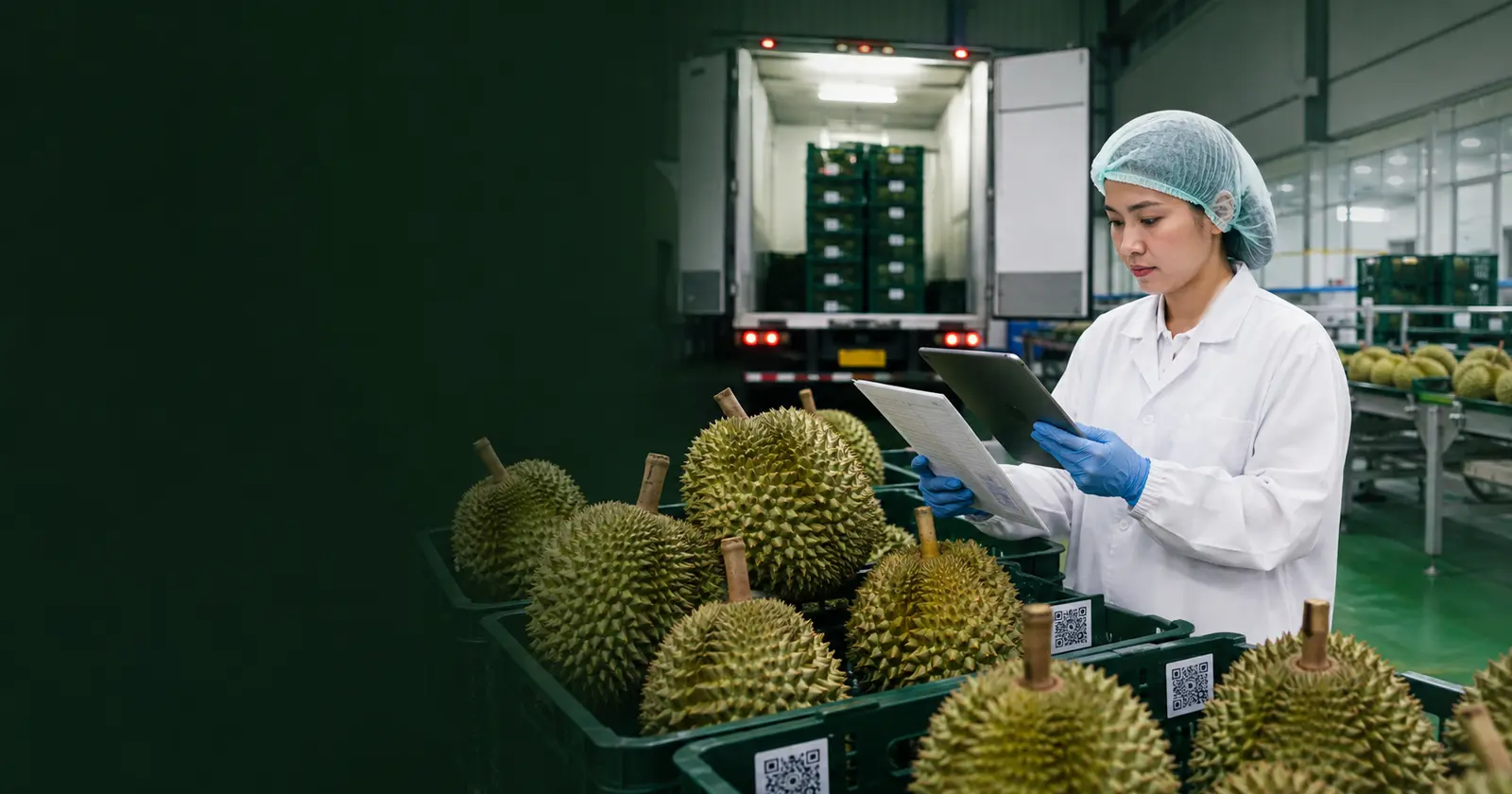
Get a durian packhouse ready for audits and China export
An audit readiness checklist for durian packhouses, from the orchard register, receiving and lots to quality evidence and traceability before export to China.
By the DurianTradeX team · Updated · Reading time 10 minPrimary keyword: durian packhouse standards for China export
- An audit-ready packhouse must be able to prove which orchard each lot came from, who checked it and which criteria it passed.
- Use a central register to control GAP status, certificates, staff and evidence, with alerts before anything expires.
- Set up an inbound gate and a shipment gate to stop items with incomplete data before the risk reaches the import checkpoint.
Short answer: what an audit-ready packhouse needs
An audit-ready durian packhouse isn’t measured by the number of files it keeps, but by its ability to show linked evidence from the orchard, supplier, receiving inspection, maturity and quality, lot and packing to cartons, pallets and the shipment. That data must be current, have an owner and be quick to retrieve. Thailand’s National Bureau of Agricultural Commodity and Food Standards (ACFS) has published TAS 9070-2023 for inspecting and receiving durian at collection centres and packhouses, and the Department of Agriculture (DOA) continues to stress control of durian exported to China in the 2026 season. Operators should check the latest requirements before every season and every shipment.
- Registrations and certificates are still valid.
- Only approved orchards and suppliers are accepted.
- Receiving results and lots link through to the shipment.
- Any retrospective change to a record has a reason and an approver.
- Exceptions have a hold, CAPA and evidence that the issue was closed.
Build one compliance master register
Bring orchards, packhouses, exporters, buyers, laboratories, quality controllers and certificates into one central register. Record the document number, issuing agency, start date, expiry date, scope, verification status and data owner. Avoid using orchard or packhouse names as the primary key, because different spellings can let in fruit from someone who isn’t approved. The system should use a unique internal code and store the official registration number as an attribute.
- Send alerts 90, 60 and 30 days ahead.
- Block purchasing when the status is expired, suspended or evidence missing.
- Keep document copies with their review history.
- Verify data against official channels, not just a photo of the document.
Set an inbound gate before durian enters the packhouse
Before weighing in, confirm that the orchard and supplier are on the approved list, the relevant documents are still valid and the truck or containers don’t create a contamination risk. Then create a lot ID straight away, with the time, weight, variety, orchard, supplier, inspector and photo evidence. Maturity checks and receiving should follow the method your organisation has adopted, in line with the relevant standards and requirements. Results shouldn’t be filled in retrospectively once packing has started.
- Never use a temporary lot that isn’t linked to a farm ID.
- Set a sampling plan and who has authority to decide the result.
- Lots still awaiting results must stay in QC pending or quality hold status.
- Any override needs a reason, an approver and an audit trail.
Make traceability answer an auditor’s question within 30 minutes
An auditor should be able to pick any carton or shipment, and the system should trace back to the inbound lot, orchard, inspection results, operators and related documents, and forward to the cartons, pallets, container, seal and the buyers who received the goods. Run a mock trace every season and after any major system or process change, measuring both completeness and time taken. A QR code on its own isn’t traceability if the source data hasn’t been approved.
- One step back: shipment → carton/pallet → batch → lot → orchard.
- One step forward: orchard/lot → batch → shipment → buyer.
- Check the mass balance to find missing lots or inflated quantities.
- Record gaps and issue CAPAs with a closing date.
Control hygiene, prohibited substances and contamination risk
The lesson from the Basic Yellow 2 measures is that one packhouse’s mistake can lead to an export suspension and damage confidence in the whole chain. Packhouses should set clear rules for the list of permitted chemicals, storage points, issuing, cleaning, control of equipment that touches the product and approval of outside service providers. Where additional testing is required, check the sampling method, accepted laboratories and result status before releasing a shipment, according to the regulator’s latest announcements.
- Keep cleaning chemicals away from product areas.
- Never use unapproved substances or dyes.
- Keep the chain of custody for test samples.
- When you find a nonconformity, hold the related product and assess the scope immediately.
Use an evidence matrix instead of preparing files on audit day
Build a table linking each requirement to its SOP, form, actual records, evidence owner, frequency and storage location, then spot-check the evidence every week. Management should see missing evidence, certificates about to expire, lots on hold and overdue CAPAs on an exception dashboard. This cuts the rush to assemble files before an audit and keeps daily practice in line with what you have documented.
- Use maker, checker and approver for high-risk data.
- Lock records after approval and use revisions for changes.
- Back up data and test recovery.
- Set retention periods by law, standards, contracts and risk, choosing the stricter rule where they overlap.
A 30-day plan for packhouse managers
In week one, carry out a gap assessment and stop using duplicate registers. In week two, set up the approved list with certificate status. In week three, put the inbound gate, quality hold and shipment gate in place. In week four, run a mock audit from a single carton back to the orchard and forward to the buyer, and test a recall. If you can’t find key evidence within the target time, treat it as an operational risk and fix it before increasing purchase volumes.
- KPI: approved supplier compliance of 100% before receiving.
- KPI: trace completeness of at least 99% and zero items missing evidence before container release.
- KPI: zero overdue CAPAs for critical issues.
- KPI: mock trace retrieval time of 30 minutes or less.
Frequently asked questions
How does TAS 9070-2023 relate to durian packhouses?
It is the code of practice for inspecting and receiving durian at collection centres and packhouses, covering controls to ensure the durian is mature and of good quality. Operators should check the latest scope and enforcement status with ACFS, their certification body and the DOA for their type of business and destination market.
Is an orchard’s GAP certificate enough to accept durian into the packhouse?
No. The packhouse must check the status and scope of the evidence, link the orchard to the actual lot, record the receiving results and maintain traceability through packing and export.
Which evidence should a packhouse be able to retrieve fastest?
The approved list of orchards and suppliers, receiving results by lot, maturity and quality evidence, packing records, carton or pallet numbers, container and seal, relevant test results, and the history of holds, releases and CAPAs.
Where should we check official information before exporting to China?
Check announcements and services from the DOA, standards information from ACFS, and buyer or GACC requirements through channels recognised by Thai agencies, recording the date checked in the shipment checklist every time.
How can AI help a packhouse’s audit readiness safely?
AI is well suited to warning about certificates nearing expiry, checking for document gaps, summarising exceptions and helping find evidence. But approving lots, releasing shipments and interpreting key requirements must be reviewed and approved by a responsible person.
Official sources
Information last checked on 11 August 2026
- TAS 9070-2023: code of practice for inspecting and receiving durian at collection centres and packhouses (Thai)National Bureau of Agricultural Commodity and Food Standards (ACFS) · Published 8 December 2024
- DOA tightens durian inspections before export to China ahead of the 2026 season (Thai)Department of Agriculture, Thailand · Published 20 February 2026
- GACC on-site audits of Thai fruit production sites, packhouses and laboratories (Thai)Department of Agriculture, Thailand · Published 23 June 2025
- Export suspension of packhouses linked to Basic Yellow 2 contamination (Thai)Department of Agriculture, Thailand · Published 5 February 2025
- GAP DOA Online (Thai)Department of Agriculture, Thailand · Last checked 11 August 2026