Durian reefer claims: collect evidence from loading to delivery
A guide to building a reefer evidence pack for durian, from fruit condition before loading, temperature logs, alarms, off-power events and seals to surveys and loss calculation.
By the DurianTradeX team · Updated · Reading time 13 minPrimary keyword: durian reefer claim
- Short answer: to get a durian reefer claim assessed faster, you need to prove in sequence what was loaded and in what condition, how the transport was set, when the incident happened, who responded, how much fruit was damaged and what evidence the loss figure is based on. A temperature log on its own is not enough.
- Open an incident as soon as something is abnormal. Preserve the goods and packaging; photograph the container, seal, load position and fruit condition; notify the counterparty, carrier and insurer as your documents require; and consider a joint survey before goods are moved or destroyed.
- Tracking platforms can show temperature, humidity, off-power, defrost, GPS and milestones, but keep the original files, a standard time reference and the data source, linked to container, seal, lot, pallet and owner in a way that can be audited later.
The answer first: a good evidence pack tells the whole story
A reefer evidence pack is one file per shipment that links fruit condition before loading, transport instructions, unit performance, events in transit, condition on delivery and the value of the loss. The goal is not to collect many files, but to let the buyer, carrier, surveyor, insurer and legal team check the sequence of events from one set of data. Hapag-Lloyd’s cargo claims page says a notice should include shipment details such as the B/L or SWB, container number, documents and photos, and that a joint survey should be considered when damage is significant; the documents actually required depend on each case. Exporters must therefore always check their own B/L, booking, sales contract, insurance policy and counterparty terms.
- One incident ID per event and one owner.
- Keep original evidence and working copies separate.
- Use ISO 8601 times with time zone, and record the clock source.
- Link container, seal, shipment, lot, pallet and buyer completely.
- Record both events and responses, not just charts.
- Seek case-specific advice from the carrier, insurer, surveyor or legal specialists.
Never conclude the cause from a single line on a chart
Supply air, return air, ambient and product or pulp temperatures are measured in different places and answer different questions. Defrost, door-open, off-power or signal gaps can change the chart without meaning the fruit was damaged immediately. Read them together with transport instructions, loading pattern, actual times, fruit condition and destination results.
Digital data supports decisions but does not guarantee a claim
Some carriers’ platforms provide downloadable milestone, alarm, off-power and datalog charts, but access, data frequency, retention and use depend on the service and contract. Having the data does not mean liability or compensation is automatically accepted.
Before loading: establish a baseline that the fruit was sound and ready to ship
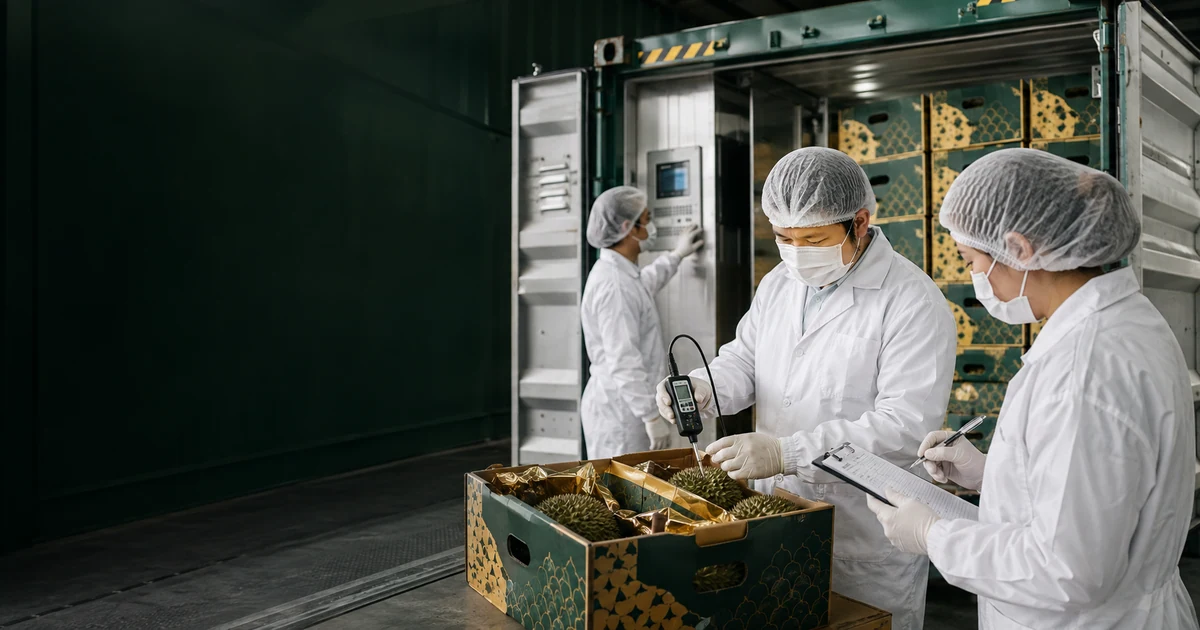
Many disputes start because nobody can prove the condition of the goods before delivery. Build a pre-loading baseline per lot and loading point, recording QC results, ripeness or the agreed quality criteria, fruit temperature, sampling method, instruments and calibration status, carton condition, vents, pallets, quantity, weight, timed loading photos and inspector. This data must match the packing list and loading plan, not generic photos that do not show which container they belong to.
- Approved transport instruction: setpoint, ventilation, humidity or CA and any special conditions.
- PTI or container acceptance, and a photo of the controller before loading.
- Pulp or product temperature under the sampling plan your organisation has approved.
- Farm, inbound lot, packing batch, carton and pallet and position in the container.
- Date and time of door opening, start and end of loading, door closing, power-on and gate-out.
- Wide, medium and close-up photos showing container number, seal and context, with original files left unedited.
The container’s refrigeration should not be used to fix fruit that is warmer than planned
Carriers’ reefer handling guidance stresses proper product preparation and airflow. Packhouses should set fruit-temperature acceptance criteria and hold fruit that fails, rather than hoping the unit will pull down a large mass of fruit after the doors close, which makes charts and the cause of damage harder to interpret.
In transit: keep raw data together with event context
As of 22 August 2026, MSC’s reefer tracking service states it can show temperature, humidity, GPS, off-power, defrost and datalogs depending on the package, while Maersk Captain Peter shows a journey log, temperature, humidity and atmosphere, milestones, off-power and hourly data downloads under the service entitlement. Exporters should download original files and snapshots at key moments rather than relying only on screenshots from chats, and record the system name, time range, time zone, units, sampling interval and download time.
- Unedited raw datalog, with file name and a hash where possible.
- Readable charts that reference the same raw data.
- Plug-in and unplug, gate, vessel, transshipment, customs and delivery events.
- Alarm codes, start and end times, who was notified and what action was taken.
- Periods of missing or delayed data, with the provider’s explanation where available.
- Emails, tickets, call logs and escalation reference numbers.
Use an event model to avoid time and identity mismatches
GS1 EPCIS 2.0 supports sensor data and supply-chain events by recording what, when, where and why, which makes it a useful model for linking temperature readings to container, pallet, lot, location and business step. Even without full EPCIS, define event ID, event time, record time, device ID, unit, source and business context consistently across every system.
On delivery: stop further change and open an incident
If you find an abnormal smell, collapsed cartons, water, damage, or temperature or quality that does not match, secure the goods and open an incident before sorting, discarding, discounting or repacking. Hapag-Lloyd advises photographing the goods and container, notifying customer service, considering a joint survey when damage is significant and notifying the insurer if there is a policy. Actual procedures and deadlines differ by counterparty, so use a playbook with contacts and the requirements for each shipment.
- Record date and time, place, who found it, weather and the unit’s power status.
- Check container number, seal and any signs of tampering before opening.
- Video or continuous photos from door opening to the position of the goods.
- Measure temperatures under the procedure, without choosing only points that support a conclusion.
- Segregate suspect goods with hold labels and maintain chain of custody.
- Request a joint or independent survey according to the extent of damage and advice from those involved.
Do not destroy or sell goods before collecting evidence and assessing salvage
Decisions about damaged goods involve safety, law, residual value and contractual rights. Record the instruction, approver, reason, quantity and evidence before acting, and coordinate with the insurer or specialists as the case requires.
Separate cause evidence from damage evidence
Evidence of cause and evidence of damage are two different sets. Cause evidence shows what happened to the system or process, such as a long off-power period, alarms or a wrong setpoint. Damage evidence shows how much the goods were actually harmed, such as survey results, carton condition, regrading, rejects, weights and sample photos. An abnormal chart with no product inspection, or damaged fruit with no sequence of events, makes analysis and negotiation difficult.
- Cause: PTI, setpoint, datalog, alarms, power, doors, route and response.
- Damage: survey, destination QC, sampling, photo map, quantity and weight.
- Causation: a timeline that carefully compares events with changes in fruit condition.
- Alternative causes: ripeness before loading, packaging, airflow, delays and handling after delivery.
- Expert opinion: name the expert, method, assumptions and limitations.
- Never use AI to conclude liability or to invent missing data.
Use AI to organise the file, not to decide the case
AI can read file names, build a timeline, spot mismatched container, seal or lot numbers and list missing evidence. Interpreting cause, liability, compensation and legal issues must be reviewed by authorised people, surveyors, insurers or relevant advisers.
Calculate the loss in a way that can be traced back
Build a damage schedule by lot, grade and package, separating sound, damaged, recovered, discounted, destroyed and remaining quantities. Then link the commercial invoice, purchase cost, packing cost, freight, duties and charges, survey, disposal and credit notes on the basis the contract or insurer accepts. Do not mix forecast costs with evidenced costs, and do not claim every item is recoverable.
- Quantities and weights must reconcile with the packing list and delivery report.
- Each amount has a source document, currency and exchange rate.
- Separate actual loss, salvage value, additional expenses and business impact.
- Prevent duplicate claims between buyer, exporter, carrier and insurer.
- Keep quotations, receipts, credit notes and proof of actual payment.
- Have finance, commercial and the claim owner verify the figures together.
The loss is not automatically the invoice value
The basis of compensation, limits of liability, excluded losses, consequential costs and deductibles depend on the contract, B/L, policy, jurisdiction and facts of the case. This guide is about organising data; it is not legal advice or a guarantee of any claim outcome.
Close the incident with CAPA and supplier and carrier scorecards
Once the case is settled, run a root-cause review that separates what is proven, what is possible and what data is still missing. Issue CAPA with owners and due dates, then update transport instructions, packaging, sampling, alert thresholds, escalation and route selection. Link claim data to container P&L so management sees the real cost, and do not close the matter just because compensation was or was not received.
- KPI: incident notification lead time.
- KPI: evidence completeness within 24 hours.
- KPI: containers with complete raw datalogs and pre-loading baselines.
- KPI: claim cycle time and settlement variance.
- KPI: repeat incidents by route, carrier and equipment.
- KPI: losses prevented by alerts handled in time.
- Review the playbook every season and after any critical incident.
A 14-day starter plan
Days 1–3: evidence checklist and contact matrix. Days 4–6: incident ID, folders, naming and permissions. Days 7–9: link loading, temperature and delivery evidence. Days 10–12: test building a file from a past container. Days 13–14: run a mock claim to measure how long it takes to find evidence and close gaps before the export season.
Frequently asked questions
Does a durian reefer claim need a temperature log?
It should have one when temperature-controlled conditions are involved, but a temperature log alone is not enough. Read it with the transport instruction, PTI, fruit temperature before loading, loading, power and alarm events, condition on delivery, survey and evidence of the loss value.
If damaged durian is found, should we open the container and sort immediately?
First secure the goods, record the container and seal condition and open an incident under your playbook. If sorting is needed for safety or to preserve value, record it continuously and coordinate with the carrier, insurer or surveyor as the case requires.
Can a screenshot of the temperature chart replace the datalog?
Not entirely. Screenshots are fine for quick communication, but keep the raw datalog or files downloaded from the official source, with time range, time zone, units, data source and download date, so it can be checked again.
Who should own a reefer claim?
One claim owner should coordinate, with QA covering condition and sampling, logistics covering the timeline and carrier, commercial covering the counterparty, finance checking the value, and management or an authorised person approving the filing and any settlement.
Within how many days must damage be notified?
There is no single number for every case. Check the B/L, booking terms, sales contract, insurance policy and applicable law as soon as the incident is found, and notify the parties without delay through the required channels. If unsure, get case-specific advice from a specialist.
How can AI help build a durian claim file safely?
AI can classify files, build a timeline, spot mismatched references, list missing evidence and link events. It must cite source files, never edit raw data, and never decide cause, liability or compensation in place of specialists.
Official sources
Information last checked on 22 August 2026
- Cargo Claims — damage notification, documents, photos and joint surveyHapag-Lloyd · Checked 22 August 2026
- Captain Peter — journey log, off-power, notifications and datalog downloadA.P. Moller–Maersk · Checked 22 August 2026
- MSC iReefer — temperature, humidity, milestones, off-power, defrost and datalogMediterranean Shipping Company (MSC) · Checked 22 August 2026
- EPCIS/CBV 2.0 — sensor data and cold-chain eventsGS1 · Checked 22 August 2026
- GHP and HACCP Toolbox: Transportation and related Codex textsFood and Agriculture Organization of the United Nations (FAO) · Checked 22 August 2026
- TAS 9070-2023: code of practice for inspecting and receiving durian at collection centres and packhouses (Thai)National Bureau of Agricultural Commodity and Food Standards (ACFS) · Published 8 December 2024