Durian container VGM: check weight, seal and lot before sailing
A loading-gate guide for closing durian containers: match VGM, weights, container, seal, lot, documents and cold-chain evidence before cut-off to cut the risk of rolled boxes and cargo claims.
By the DurianTradeX team · Updated · Reading time 9 minPrimary keyword: durian container VGM
- Under SOLAS, VGM is a condition for loading a packed container onto a vessel. The shipper must send the verified weight to the carrier or terminal in time for the stowage plan.
- A good loading gate makes container number, seal, lot, cartons or pallets, weight, shipment and reefer evidence agree in a single data set.
- If the data doesn’t match, hold the container and open an exception with an approver. Never overwrite history or release because cut-off is close.
Short answer: what must be closed before the vessel sails
Before a durian container leaves the packhouse, it must pass a loading gate that confirms five things together: the right container, the right lot, a verifiable weight, a seal that matches the documents, and evidence ready to send to the parties involved. For sea transport under SOLAS, a packed container must have a Verified Gross Mass (VGM) before it is loaded, and the shipper must send it to the master or their representative and the terminal early enough for the stowage plan. Cut-off, document format and VGM submission channels can differ by carrier or terminal, so check the booking confirmation and the provider’s latest instructions on every sailing.
- Container number and type match the booking.
- The seal number actually applied matches the loading record and the documents.
- Lot, cartons and pallets link back to the orchard, QC results and the shipment.
- VGM has a calculation method, a responsible person, a date and time, and evidence.
- Hold statuses, inspection results and documents that condition release are all closed.
Understand VGM correctly before closing the container
VGM is the verified gross mass of the packed container, not just the net weight of the durian. The International Maritime Organization sets out two main methods. Method 1 weighs the whole packed container. Method 2 weighs the cargo, packaging, pallets, dunnage and securing materials and adds the container tare. The method and scales must meet the certification or requirements of the competent authority in the country concerned. The shipper is responsible for giving the VGM in the shipping document, and should confirm that the shipper definition matches the bill of lading and the carrier’s terms. Net weight, cargo gross weight and VGM should never be used interchangeably.
- Net weight: the net weight of the cargo.
- Cargo gross weight: cargo plus packaging, as your organisation defines it.
- Tare: the empty weight stated for that specific container.
- VGM: the verified total weight of the packed container.
- Keep weighbridge tickets, scale ID, calibration status and operator according to the approved method.
Build one container loading gate
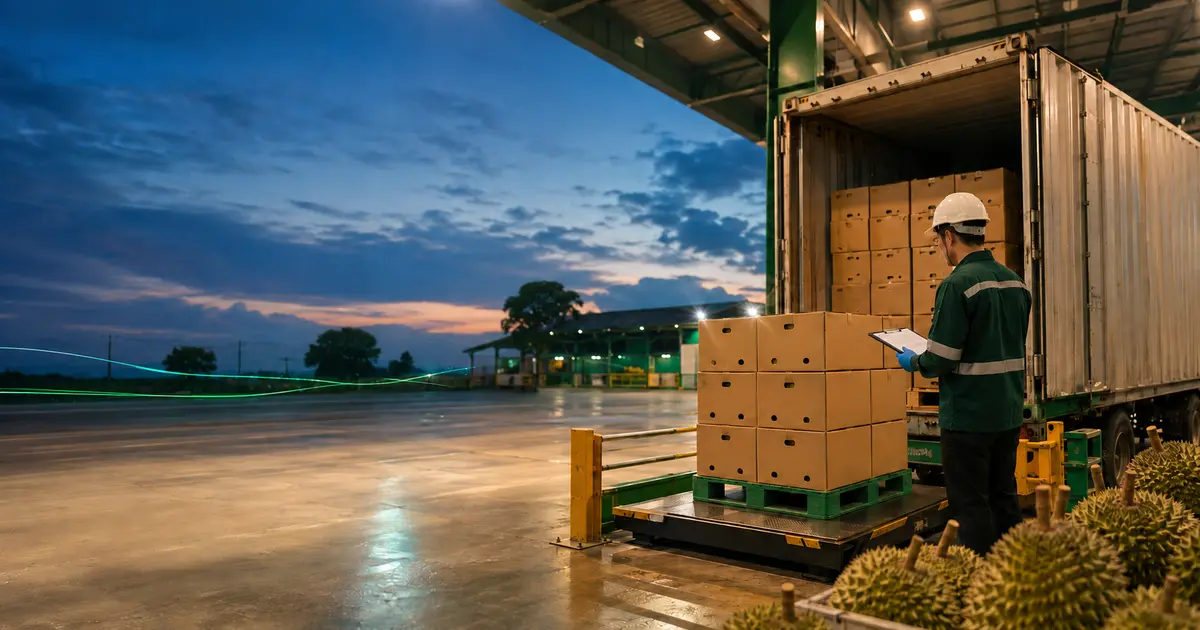
Start the gate when the empty container arrives, not after the doors close. Check the container number, type, cleanliness, odour, damage, floor, doors, gaskets and reefer readiness against the approved plan. Then scan or record every pallet into the container, with the system blocking lots on hold or shipments that don’t match the booking. When loading finishes, record the seal position, a photo of the closed doors, the time leaving the packhouse, the truck, the driver and the reviewer. Keep the evidence in one container record so the packhouse, logistics, documents and finance never work from different versions.
- Booking, shipment ID, container number and truck number
- Seal number with photos before and after applying
- Pallet ID, carton count, lot ID and farm ID
- Net, packaging, pallet and dunnage, tare and VGM
- Loading start and finish, gate-out and the cut-off used
- Maker and checker for every value that affects release
Run a mass balance from lot to VGM
Weight should be explainable from fruit receipt through grading, packing and palletising to the container. A balance check doesn’t force every figure to be equal; it explains the differences with clear units and data sources, such as waste, rejects, carton weight, pallets, dunnage and scale tolerance. Set tolerances from the weighing method, instruments, contract and your risk appetite, rather than copying a standard percentage from an unrelated source. If the pallet total differs from the container weighbridge ticket by more than the threshold, check unit conversion, the container tare, missing cartons or double scans before changing any data.
- Use kilograms as the common unit and lock the source unit.
- Calculate expected VGM from the approved line items.
- Compare expected VGM with measured VGM.
- Every difference needs a reason code and a reviewer.
- Never adjust weights to pass without evidence.
Tie lots and quality evidence to the shipment
A correct container number and VGM are not enough if the fruit inside can’t be traced back to the orchard and its test results. TAS 9070-2023 sets the code of practice for inspecting and receiving durian at collection centres and packhouses, and the ACFS page on mandatory standards says it has been in force since 10 July 2025. Operators should check their licence status, scope and applicable requirements through the latest official channels before acting. The loading gate must only pull pallets from approved lots, and link receiving inspection, maturity, quality, any conditional lab results and orchard documents to the same shipment.
- Scan pallet to container, with cross-shipment loading blocked.
- Check one step back to lot, farm and supplier.
- Check one step forward to container, seal and buyer.
- A QC Pending or Quality Hold status must block loading or release.
- Run a mock trace from seal back to orchard within a set time.
Control the reefer and cold-chain evidence without guessing values
For temperature-controlled containers, record the pre-trip inspection where it is in scope, plus setpoint, ventilation, mode and the time cooling started, following the product specification, the contract and the carrier’s or specialist’s guidance for the actual cargo. This article does not set one temperature for every durian shipment, because ripeness, packaging, distance and buyer terms differ. A single photo of the reefer display is not evidence for the whole journey. Link device ID, time, position and alerts to the container record, and name who is responsible when power fails, the doors stay open too long or readings go out of range.
- Confirm the setpoint from the approved document version.
- Link the sensor or logger to the container number and shipment.
- Synchronise device clocks before leaving the packhouse.
- Name an alert owner and an escalation window.
- Keep handover evidence between packhouse, truck, terminal and carrier.
Handle exceptions before cut-off
The rush before sailing makes fixing figures over chat or in private files the biggest risk. Build an exception workflow for VGM outside tolerance, a changed seal, a swapped container, missing pallets, incomplete inspection results or mismatched documents. Set the status to Hold and record cause, scope, who fixes, who checks and who approves. When the seal or container must change, create a revision and notify the parties under the booking and applicable rules, without deleting the original evidence. The cost of missing a vessel should be weighed against the risk of releasing a container with wrong data; cut-off is never a reason to override.
- Critical mismatch: automatic hold.
- A revision must keep the old value, reason, date and time, and approver.
- Notify documents and logistics from the same event.
- Re-check after the fix and before gate-out.
- Keep incidents to analyse repeat causes.
A 24-hour plan and KPIs for management
Within 24 hours of cut-off, run a container readiness board showing every booking, cargo status, documents, inspection results, trucks, VGM, seal and time remaining, with exceptions in front of routine items. Before loading, freeze the approved pallet list. During loading, scan and check weights. After closing, have the checker confirm VGM, seal and evidence before gate-out is approved. Management should track both readiness and data quality so that speed doesn’t turn into hidden risk.
- VGM ready before line cut-off = 100%
- Container, seal and shipment match = 100%
- Pallets loaded without an approved lot = 0
- Loading evidence completeness = 100%
- Unapproved overrides and open critical exceptions before gate-out = 0
Frequently asked questions
What is VGM for a durian container?
VGM, or Verified Gross Mass, is the verified total mass of the packed container: cargo, packaging, pallets, dunnage and securing materials, plus the empty container weight. It must be submitted through the carrier’s or terminal’s process before the container is loaded under SOLAS.
Who is responsible for sending VGM to the carrier?
IMO says the shipper, as named on the bill of lading or sea waybill, is responsible for obtaining the VGM and providing it in the shipping document to the master or their representative and the terminal in good time. Check the roles and steps in the booking for the actual sailing.
How is VGM different from net weight and tare?
Net weight is the weight of the cargo alone, tare is the empty container weight, and VGM is the verified total mass of the packed container. Never use the three figures in place of each other.
What should we do if VGM or the seal doesn’t match before cut-off?
Hold the container, check the data sources and evidence, open an exception with an owner, and fix it through a revision that keeps history. If the container or seal changes, update every document and notify the parties through the carrier’s or terminal’s process before approving gate-out.
Can we use the sum of pallet-scale weights as VGM?
Only under Method 2, using a process and instruments certified or approved by the competent authority, and only if every component is included: cargo, packaging, pallets, dunnage, securing materials and the container tare. Check the latest Thai requirements and your provider’s rules.
How can AI help check the loading gate safely?
AI is well suited to spotting duplicate container and seal numbers, catching weights in the wrong unit, comparing expected VGM with the weighbridge ticket and summarising exceptions. Certifying VGM, changing a seal and releasing a container must still be done by an accountable person who checks the evidence and approves.
Official sources
Information last checked on 14 August 2026
- Verification of the gross mass of a packed containerInternational Maritime Organization (IMO) · Last checked 14 August 2026
- Safe transport of containersInternational Maritime Organization (IMO) · Last checked 14 August 2026
- TAS 9070-2023 Code of practice for inspection and receipt of durian at collection centres and packhouses (Thai)National Bureau of Agricultural Commodity and Food Standards (ACFS) · Published 8 December 2024
- Durian collection centres and packhouses: mandatory standard and licensing (Thai)National Bureau of Agricultural Commodity and Food Standards (ACFS) · In force 10 July 2025
- Export fruit quality control for the 2026 season and GACC-registered laboratories (Thai)Department of Agriculture, Thailand · 12 March 2026
- DOA tightens durian inspection before export to China (Thai)Department of Agriculture, Thailand · 20 February 2026