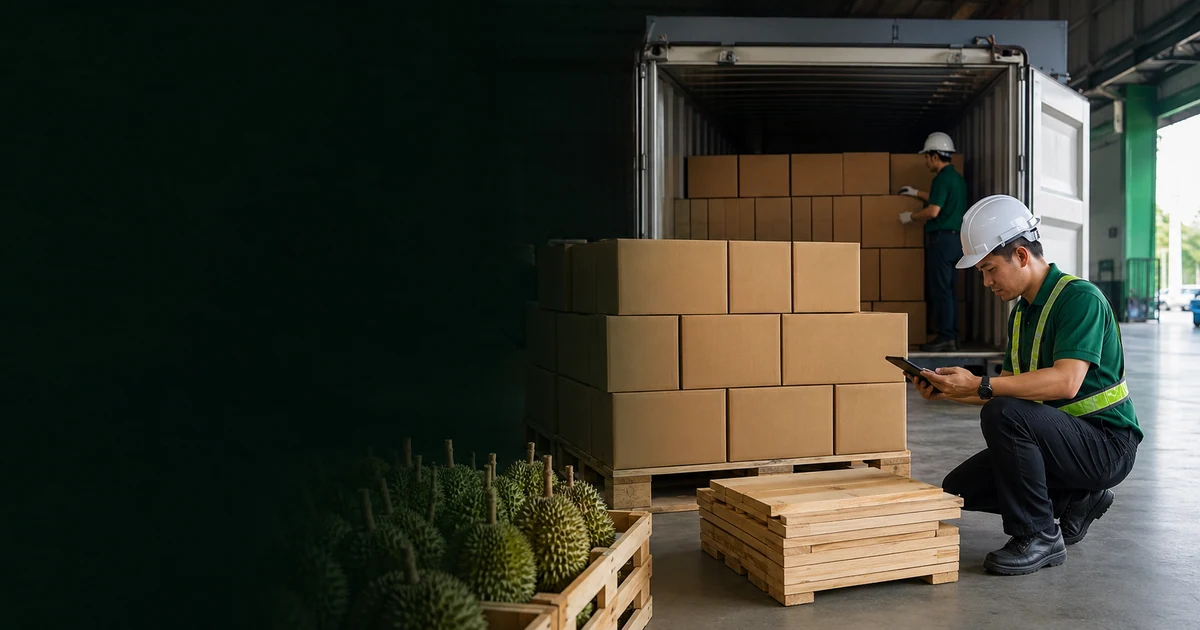
ISPM 15 for durian containers: check wooden pallets before export to China
An ISPM 15 guide for wooden pallets and dunnage in durian containers, from choosing suppliers, receiving and checking marks to quarantine, loading release and audit-ready evidence.
By the DurianTradeX team · Updated · Reading time 12 minPrimary keyword: ISPM 15 wooden pallets for China
- Short answer: wooden pallets, crates, dunnage and bracing made from raw wood in an export container fall within ISPM 15 control. Processed wood that is pest-free from its manufacturing process, such as plywood, may be outside the scope under the standard’s conditions.
- A visible IPPC mark is not an automatic pass. Check the format, legibility, position, country, producer and treatment codes, the condition of the wood and whether it matches the approved supplier.
- The most effective control point is a wood packaging release gate before the container doors close: check every unit actually used, keep photos and the pallet list, link them to the container and seal, and stop loading when you find unmarked wood or signs of risk.
The answer first: ISPM 15 doesn’t only cover finished pallets
As of 18 August 2026, the IPPC Adopted Standards page describes ISPM 15 as measures to reduce the risk of introducing and spreading quarantine pests through wood packaging material made from raw wood. It also covers dunnage, the timber used to support and brace cargo, and exempts material processed to be pest-free, such as plywood, within the standard’s scope. China has an entry for its implementation of ISPM 15 on imports in the IPPC’s official database. So a packhouse shouldn’t only check the pallets under the cartons, but also crates, frames, wedges, dunnage and any extra timber added to the container during loading.
- List every wood packaging unit before loading starts.
- Separate raw wood from engineered wood and out-of-scope materials, with evidence.
- Check the latest requirements for China and any transit countries with the official authorities before each shipment.
- Never substitute scrap timber from the site without inspection and approval.
- Have QA or the authorised release person check the product, container and securing materials as one set.
The standard reduces risk, it doesn’t guarantee condition forever
The IPPC states clearly that ISPM 15 measures don’t provide ongoing protection against contamination by pests or other organisms. Pallets that were treated and marked must still be stored in a dry, clean area away from uncontrolled wood, and checked again before use.
Don’t use this article in place of shipment requirements
Import rules, accepted treatments, mark formats and the handling of non-compliance can change, or a country may add its own requirements. Confirm with Thailand’s Department of Agriculture (DOA), the plant quarantine station, approved service providers, the carrier and the importer before applying them.
Start with approved suppliers, not with checks when the truck arrives
Purchasing should buy or rent pallets from verifiable suppliers and keep their approval status as master data. The DOA provides a registration application for wood packaging producers under IPPC requirements and related registration information, so confirm the producer or service provider through the latest official channel rather than relying on a picture of the mark in a quotation.
- Keep the verified legal name, address, contact and provider code.
- Specify the material type, size, load rating, treatment and conditions for repair or reuse.
- Record the source of verification, status, check date and next review date.
- Require QA approval before receiving from a new supplier or timber source.
- Link the purchase order, delivery note and pallet batch together.
Three risks a certificate alone doesn’t close
The paperwork may belong to a different batch, the mark on some units may be unclear, or a pallet may have been repaired with uncontrolled pieces of wood. Supplier approval therefore has to work together with receiving inspection and pre-loading verification.
Receive pallets as a lot and set their status straight away
When pallets arrive at the packhouse, create a wood packaging lot by supplier, receiving date, delivery note, type, size and quantity, and check the marks and actual condition against the approved plan. Don’t combine pallets from several sources in one stack before they are accepted, because if a problem turns up you won’t be able to limit the scope.
- Minimum statuses: received → inspection pending → accepted / hold / rejected.
- Count what actually arrived and photograph the lot before it is broken up.
- Check moisture, cleanliness, bark, insect holes, soil, mould, breakage and repairs.
- Record results per unit or per set according to a plan you can explain.
- Put hold labels where they are visible in both the system and the physical area.
- Record the inspector, time, equipment and the reason for any exception.
What to do when a mark is unclear
Don’t guess the code from the pallet next to it. Put that unit on hold, check the documents and supplier, and have QA decide according to the procedure. If it can’t be confirmed, replace the unit before loading and keep evidence that it was removed.
Learn to read the mark, and never create one yourself
The ISPM 15 mark is controlled by the national plant protection organisation (NPPO) or a body it designates. The IPPC states that approval to apply the mark can only be given by the NPPO or an organisation that has been officially audited and authorised. A packhouse or exporter has no right to print, repair or add a mark to make the paperwork look complete.
- Check the IPPC symbol and code elements against the official format.
- Check that the country and producer codes are legible and not painted over, covered or distorted.
- Check that the treatment shown on the mark matches the latest accepted list.
- The mark must be permanent, clear and in a position where it can be inspected, as required.
- Don’t accept a supplier’s photo of the mark in place of checking the real units.
- Repairs and remanufacturing must follow the authorised agency’s system.
Why one photo isn’t enough
One stack of pallets may come from several batches with different repairs. Keep an overview photo of the lot alongside close-ups of the mark in several places, and link the photos to the inspection record by time, inspector and lot code.
Control the wood store so accepted units don’t become a risk again
After acceptance, keep an accepted area separate from hold, rejected, repaired and domestic-use wood. Use FIFO based on condition and check again before issuing. A single mixed-up unit can mean unloading the container or widening an investigation to the whole container.
- Dry floor, raised off the ground and away from insects or wood debris.
- Not near raw wood, domestic-use wood or maintenance areas.
- Issue by lot ID and quantity, never “take the front stack”.
- Pallets returned from the packing line must be checked and have their status changed before storage.
- Run cycle counts and condition checks based on risk.
- Lock the right to change accepted status and keep an audit log.
Wood that comes with an empty container or a contractor
Dunnage or bracing that drivers, technicians or the loading team bring in must pass the same acceptance point as the packhouse’s pallets. If its source and status can’t be verified, keep it out of the loading area.
Set a wood packaging release gate before the container is closed
Before closing the doors and applying the seal, a checker walks the container from back to front against the loading plan, the pallet list and the securing materials actually used. This gate should come after loading is finished but before the point where changes become expensive, so the team can swap out problem units without missing the cut-off.
- Confirm the container number, shipment, order, buyer and destination.
- Scan or record the wood packaging lots actually used.
- Check every pallet, crate, dunnage, bracing, wedge and piece of wood in the container.
- Take wide shots and evidence photos at the set positions.
- Confirm there is no soil, bark, insect sign or unmarked unit, as the procedure requires.
- If there is an exception, set the container to hold and don’t issue seal approval.
- The checker and approver should be different people for high-risk containers.
System rules to set
The system shouldn’t allow loading complete or seal confirmed while any wood packaging item is pending, quantities don’t match or an exception is open. Overrides must be limited to authorised people, with a reason, evidence and a time that can be audited later.
Build an evidence pack you can find in minutes
Evidence doesn’t have to be a pile of documents, but it must prove which material came from whom, when it was checked and which container it was used in. Build a digital thread from supplier → purchase/delivery → wood packaging lot → inspection → warehouse movement → loading → container/seal → shipment.
- Approved supplier record and evidence of the latest status check.
- PO, delivery note, batch list and supporting documents actually used.
- Receiving checklist and photos of marks and condition.
- Issue records for pallets and dunnage sent to loading.
- Pre-seal checklist, photos inside the container, container and seal numbers.
- Exceptions, disposition, replacement units and approvers.
- The procedure version and market requirements on the day the container was released.
You don’t automatically need a phytosanitary certificate for every wood unit
The idea behind the ISPM 15 mark is to use a globally recognised mark instead of issuing a phytosanitary certificate for the wood packaging within the standard’s scope. Exporters still need to keep evidence of purchase and inspection, plus any additional requirements the shipment or destination country calls for.
When you find non-compliance, contain the scope before fixing it
If you find a mark in the wrong format, an unreadable code, wood with bark, signs of pests or documents that don’t match, stop using the units involved, open an incident and trace to other lots from the same source. Don’t scrape off the mark, add ink, swap documents or throw the wood away before keeping evidence, because you won’t be able to find the cause or answer the inspector’s questions.
- Hold the wood packaging lot and any containers involved.
- Record photos, position, time, who found it and its original condition.
- Trace back to the supplier and forward to containers that may already have used it.
- Assess replacement, rework, treatment, return or disposal as directed by the authority.
- Notify QA, export, logistics and management according to severity.
- Carry out root cause analysis and CAPA, and check effectiveness before releasing the hold.
Where AI can help
AI can read codes from photos, flag duplicate photos, check for incomplete pallet lists and find containers that received the same lot. But it shouldn’t confirm that a mark is valid, diagnose pests or approve release without a responsible person checking the real units.
KPIs and a 14-day upgrade plan
In week one, survey wood materials at every point and set up approved suppliers, lot IDs, store statuses and a receiving form. In week two, link issues to the loading plan, trial a hold on one container, test trace-back and train the receiving, store, production, loading and documentation teams on the same scenario. Management should look at exceptions and completeness before looking at the average cost per pallet.
- Wood packaging traceability completeness = 100%.
- Containers sealed with an open wood packaging exception = 0.
- Unverified wood units found at the pre-seal gate = 0.
- Time to trace from container to supplier lot.
- Rate of unreadable marks by supplier.
- Number of late substitutions during loading.
- Overdue critical CAPAs = 0.
The business goal
A good system reduces unloading, hold risk and time spent chasing documents, and shows purchasing the real cost of quality from each pallet supplier, rather than comparing price per pallet alone.
Frequently asked questions
Does ISPM 15 apply to plastic pallets?
No. The standard covers packaging made from raw wood. Plastic pallets still need to meet cleanliness, strength and food safety requirements and any relevant buyer conditions.
Do plywood pallets need an IPPC mark?
ISPM 15 exempts wood material processed to be pest-free, such as plywood, within the standard’s scope. But you must confirm that the actual material meets the conditions and check the latest destination country or contract requirements. Don’t decide from the trade name alone.
Can a marked pallet be reused indefinitely?
Don’t assume so. The mark shows compliance with the system at a given point, but the IPPC states that the measures don’t give ongoing protection against later contamination. Check condition, repairs, storage and validity before every use.
What should we do if we find unmarked bracing after loading is finished?
Hold the container before sealing, record the evidence, remove that unit safely, check the scope of wood from the same source and use approved replacement material. Then have the authorised person re-inspect and re-approve.
Does every pallet with an IPPC mark need its own certificate?
The standard relies mainly on the recognised mark instead of a phytosanitary certificate for wood packaging within the scope of ISPM 15. But packhouses should keep the PO, delivery note, batch, supplier, inspection results and any evidence the market or shipment actually requires.
Who is allowed to apply the ISPM 15 mark?
The IPPC states that approval to use the mark comes from the NPPO or an organisation that has been officially audited and authorised. Packhouses, exporters or contractors without approval shouldn’t apply, repair or add the mark themselves.
Official sources
Information last checked on 18 August 2026
- ISPM 15: Regulation of wood packaging material in international tradeInternational Plant Protection Convention (IPPC) · Adopted Standards page checked 18 August 2026
- Guide to Regulation of Wood Packaging Material and the role of the ISPM 15 markInternational Plant Protection Convention (IPPC) · Published 3 May 2023; checked 18 August 2026
- FAQ: implementing ISPM 15 and who can authorise the markInternational Plant Protection Convention (IPPC) · Checked 18 August 2026
- Implementation of ISPM 15: ChinaInternational Plant Protection Convention (country information from official authorities) · China measures list checked 18 August 2026
- Application forms and services for wood packaging producers under IPPC requirements (Thai)Office of Agricultural Regulation, Department of Agriculture, Thailand · Checked 18 August 2026
- Guidance on wood packaging material for export (Thai)Office of Agricultural Regulation, Department of Agriculture, Thailand · Checked 18 August 2026