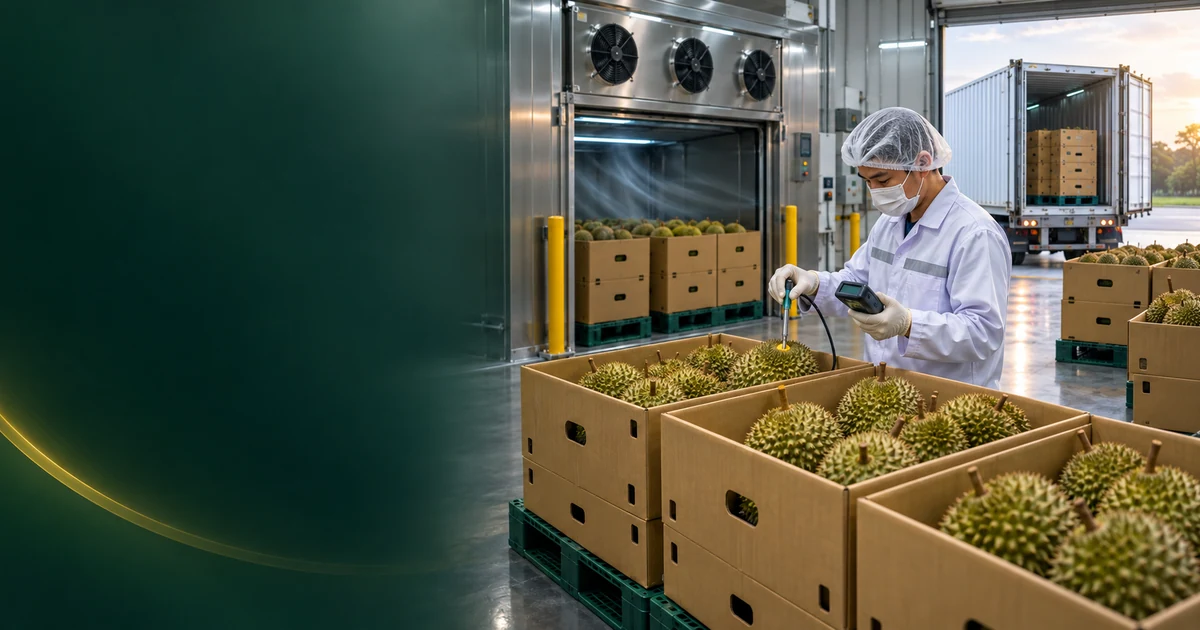
Pre-cooling export durian: remove field heat before loading
A guide to pre-cooling export durian with a pre-cooling release sheet: measure product temperature and control field heat, airflow, the loading bay and the evidence you need before loading a reefer.
By the DurianTradeX team · Updated · Reading time 13 minPrimary keyword: pre-cooling export durian
- Short answer: pre-cooling must bring approved durian to the release temperature in the product specification before stuffing starts, with real readings from several positions recorded on a pre-cooling release sheet. A reefer is there to hold temperature in transit; it should not stand in for a cold room to cool warm fruit.
- Measure product temperature, not just room air or the setpoint. Use a sampling plan that covers lots, pallets, positions and time, with traceable instruments. If readings are uneven, hold the batch and look for causes in airflow, packaging or stacking.
- No single pre-cooling temperature or time fits every durian variety, maturity, package, route and buyer. Targets must come from the approved specification for the actual shipment, and you must guard against chilling injury, condensation and contamination while cooling.
The answer first: a reefer holds temperature; it does not replace a pre-cooling room
Hapag-Lloyd and MSC agree that reefers are designed to maintain a set temperature during the voyage, not to pull heat quickly out of warm cargo down to carrying temperature. Before stuffing, confirm that product temperature matches the transport instruction, and load from a temperature-controlled area. Good practice is a pre-cooling release gate kept clearly separate from PTI and the reefer setting gate: the PTI confirms the machine is ready, pre-cooling confirms the product is ready, and the setting gate confirms the values set on the container.
- Product ready: the lot has passed QC and reached release temperature.
- Equipment ready: the container has passed PTI, is clean and has no critical alarms.
- Documents ready: product specification, booking and setting sheet are on the same revision.
- Bay ready: the loading area is clean, door-open time is controlled and heat pick-up is minimised.
- Evidence ready: instrument, operator, time, measuring points and approval are complete before loading.
Keep setpoint, room air and product temperature apart
The setpoint is the instruction to the controller, room air is the air condition in the room, and product temperature is the temperature of the fruit at the point measured. All three can differ. Seeing the cold-room display at target does not prove every pallet of durian is ready to load.
Values from an old shipment are not an automatic specification
Variety, maturity, fruit size, packaging, distance, buyer conditions and equipment all change the heat load and the risk. Reusing old values requires a fresh review and approval; don’t copy them just because the destination is the same.
Design a 16-field pre-cooling release sheet
One release sheet per shipment or clearly defined batch lets the next shift repeat the process and keeps the evidence consistent with the container loading record. Every value needs a timestamp and a source. When something changes, open a revision instead of overwriting.
- 1 Shipment, booking, container and route.
- 2 Product, cultivar, maturity or grade, lot, and farm or packhouse.
- 3 Product specification and the approved revision.
- 4 Cooling method: room cooling or forced-air, as planned.
- 5 Target release temperature and acceptance range with unit.
- 6 Measuring points: fruit, carton and pallet position, and method.
- 7 Sampling plan and number of samples.
- 8 Initial product temperature with start time.
- 9 Room, supply and return air used to monitor the process.
- 10 Intermediate checks and the cooling curve.
- 11 Final product temperature by point.
- 12 Instrument, asset number and calibration status.
- 13 Packaging and vent alignment, and pallet layout.
- 14 Loading-bay condition and the time fruit left the cold room.
- 15 Result: Ready, Hold or Approved exception.
- 16 Operator, checker, approver and audit timestamp.
Keep raw readings, not just averages
An average can hide a hot spot at the edge of a pallet or the centre of a carton. Keep readings point by point with their positions so you can see the spread. If the system calculates averages or trends, it must be possible to go back to the raw data.
Choose the cooling method from the product and packaging
USDA Agriculture Handbook 66 says initial cooling should take place in facilities designed to remove heat from produce, and explains that room cooling and forced-air cooling have different airflow patterns and times. For whole durian, the handbook lists forced-air or room cooling as options, but a commercial design must be calculated by specialists from actual fruit size, cartons, batch volume, equipment capacity and the quality specification.
- Room cooling: simpler to build, but can be slow and uneven when cartons block the airflow.
- Forced-air cooling: pushes cold air through carton vents and the pallet stack, narrowing the gap between surface and core faster when designed correctly.
- Hydrocooling or water: never assume it suits durian; specialists must assess hygiene, packaging, disease risk and suitability.
- Transport cooling: should not be the main plan for warm fruit, because a reefer’s airflow and time are designed for carriage, not for removing initial field heat.
Air paths must be continuous from carton to plenum
Carton vents that exist but are blocked by bags, paper, fruit or pallets add resistance to airflow. Check vent alignment, return-air paths, tunnel tarps and seals, and the pressure path before starting each batch.
Large durian don’t all cool at the same rate
Fruit size, position in the carton and stack density all affect the cooling curve. Group batches with similar characteristics and confirm with real measurements; don’t set the time by the clock alone.
Build a traceable product-temperature measurement plan
Each reading must show which lot, which fruit, which point, which instrument, what time and who measured it. Cover the start, middle and end of the batch, pallets near and far from the air source, outer-layer cartons and the positions expected to cool slowest. Destructive or probing methods need hygiene and sample-handling approval; never return probed fruit to sale cartons without a safe policy.
- Set a measurement SOP and use the same probe insertion points.
- Sanitise probes with the approved method and prevent cross-contamination.
- Record °C or °F clearly and block unit mix-ups.
- Check calibration status before use and run ice-point or reference checks per SOP.
- Code each sample so it links to lot, pallet and position.
- If a reading looks wrong, confirm it with a reference instrument and open a deviation.
Infrared screens the surface; it does not replace core temperature
Infrared cameras or guns find surface hot spots quickly, but readings depend on the surface, distance, angle and emissivity. Don’t use them in place of internal product temperature when the specification requires an internal value.
Control the cooling curve and half-cooling time without trusting averages
Instead of setting “so many hours in the cold room”, track the cooling curve from starting temperature to target and watch the gap between the fastest and slowest points. Half-cooling time shows when the difference between product and cooling medium has halved. Use it as an analytical tool, not a guaranteed formula, because every durian batch and air system is different.
- Record the start time when the batch is in position and the system is actually running.
- Take readings at the same intervals and never move a sensor mid-cycle without recording it.
- Look at max, min, median and spread alongside the average.
- Let the slowest point drive the decision when it is a critical quality attribute.
- Investigate flat or unusually slow curves: fans, coils, doors, air bypass, carton vents or overstacking.
- Once the target is reached, set a hold and transfer window before temperature rebounds.
The room reaches setpoint but the fruit doesn’t
Check evaporator capacity, defrost, fan status, door openings, batch load, air bypass and packaging before lowering the setpoint yourself. Setting colder than the specification to save time can raise the risk of chilling injury and complicate claims.
Prevent condensation, chilling injury and contamination
Colder is not always better. For whole durian, USDA AH-66 notes that temperatures that are too low may be associated with chilling injury and cites reference ranges from the literature, but export use must always be confirmed against the current product specification of the buyer and specialists first. Moving fruit from cold into warm, humid areas can cause condensation on fruit, cartons or equipment, so control dew point, door-open time and handling routes.
- Never speed up cooling with a setpoint below specification without an assessment.
- Monitor room RH or dew point together with temperature when condensation is a risk.
- Keep floors, walls, evaporators and drains clean and free of standing water.
- Separate held lots, rejected fruit and chemicals from fruit ready to ship.
- Set door discipline and use air curtains or an ante-room where appropriate.
- Check for soft, wet cartons or collapsed vents before release.
High humidity is not the same as good hygiene
Holding humidity can reduce water loss, but wet surfaces, standing water and drips increase quality and hygiene risks. Control must weigh product requirements, drainage, cleaning and air movement together.
Link pre-cooling to stuffing and power handover
Fruit that is ready can pick up heat again while waiting for the truck, being moved on pallets or when the container doors are open. Track the time continuously from the final release reading to door closing and the next plug-in. Hapag-Lloyd recommends loading from a refrigerated loading bay and switching the container unit off during stuffing to reduce outside-air exchange, in line with carrier practice; power must then be restored and status confirmed under the power handover plan.
- Set a maximum transfer window from the specification and on-site testing.
- Sequence pallets before opening the doors; don’t search for fruit in the loading bay.
- Record bay temperature, door-open time, first pallet in and last pallet in.
- Stop loading for rain, dew, wet cartons or heat pick-up beyond the threshold.
- After closing the doors, confirm plug-in, controller running, settings and alarms.
- Link the pre-cooling record to the load plan, seal record and container dossier.
Restart the clock when a batch falls out of control
If fruit stays out of the cold room longer than the approved window or meets unplanned conditions, put it back on hold, measure again and re-approve. Never carry the old release result forward automatically.
KPIs, cost and AI that work in practice
Good pre-cooling shows quality, time and energy together; it doesn’t cool for longer than necessary just to make the chart look good. Start with a dashboard per batch and container showing readiness, the cooling curve, slowest point, queue, energy and deviations, then use real data to adjust batch size, airflow and the loading schedule.
- Pre-cooling first-time pass rate and number of batches reworked.
- Time from harvest or receiving to initial cooling, and to release.
- Temperature spread at release against the criterion.
- Energy in kWh per tonne or per carton released.
- Door-open minutes and thermal rebound before door closing.
- Containers that started stuffing before the product was ready: target zero.
- Claims or rejections linked to initial product temperature.
AI can predict completion time and flag hot spots
A model can learn from initial temperature, fruit size, batch weight, pallet position, fan and room data and the weather to predict expected completion and detect abnormal curves. Its output must be a recommendation with a confidence level, not an automatic setpoint change or product release.
Run a comparative pilot before investing big
Capture a room-cooling baseline, then trial forced-air or a new stacking pattern on controlled batches. Compare time, spread, weight loss, defects, energy and labour before expanding capacity.
Frequently asked questions
What is pre-cooling for export durian?
It is the process of removing durian’s initial heat until it reaches the release criterion in the product specification before loading a reefer, with traceable records of product temperature at several points, the cooling method, time, instruments and approver.
Can we use the reefer to cool durian instead of a cold room?
It shouldn’t be the main plan. Container providers state that reefers are designed to maintain temperature in transit, not to pull heat quickly from warm cargo. Pre-cool the fruit so it is ready before stuffing.
What temperature should we use to pre-cool durian?
There is no single value for every shipment. Follow the approved specification for the actual variety, maturity, quality, packaging, route, buyer and equipment, and check the risk of chilling injury. Never copy values from an old shipment without a review.
Is watching the cold-room temperature enough?
No. Room temperature, setpoint and product temperature are different values. Measure the product under a sampling plan that covers lots, pallets and risk positions, and keep individual readings rather than averages only.
How do room cooling and forced-air cooling differ?
Room cooling relies on cold air in the room and is often slow or uneven when air paths are blocked. Forced-air pushes air through cartons and the stack using a plenum or tunnel, so it responds faster when the air path is designed and sealed correctly. The right method must be confirmed from the product, packaging, equipment capacity and real trials.
How can AI help with pre-cooling?
AI can predict time to target, flag abnormal cooling curves, find hot spots and schedule batches and loading from real data. It should not release fruit, change setpoints or skip QC automatically.
Official sources
Information last checked on 6 September 2026
- Reefer Cargo Handling — recommendations prior to stuffingHapag-Lloyd · Checked 6 September 2026
- Pre-cooling of temperature-sensitive cargoesHapag-Lloyd · Published 17 May 2021; checked 6 September 2026
- What is a reefer container: The comprehensive guideMSC · Published 26 August 2025; checked 6 September 2026
- Cold Chain Management for Reefer CargoMSC · Published 15 January 2026; checked 6 September 2026
- The Commercial Storage of Fruits, Vegetables, and Florist and Nursery Stocks — Agriculture Handbook No. 66USDA Agricultural Research Service · Revised 2016; checked 6 September 2026
- CXC 44-1995 Code of Practice for Packaging and Transport of Fresh Fruit and VegetablesCodex Alimentarius (FAO/WHO) · Amended 2004; checked 6 September 2026