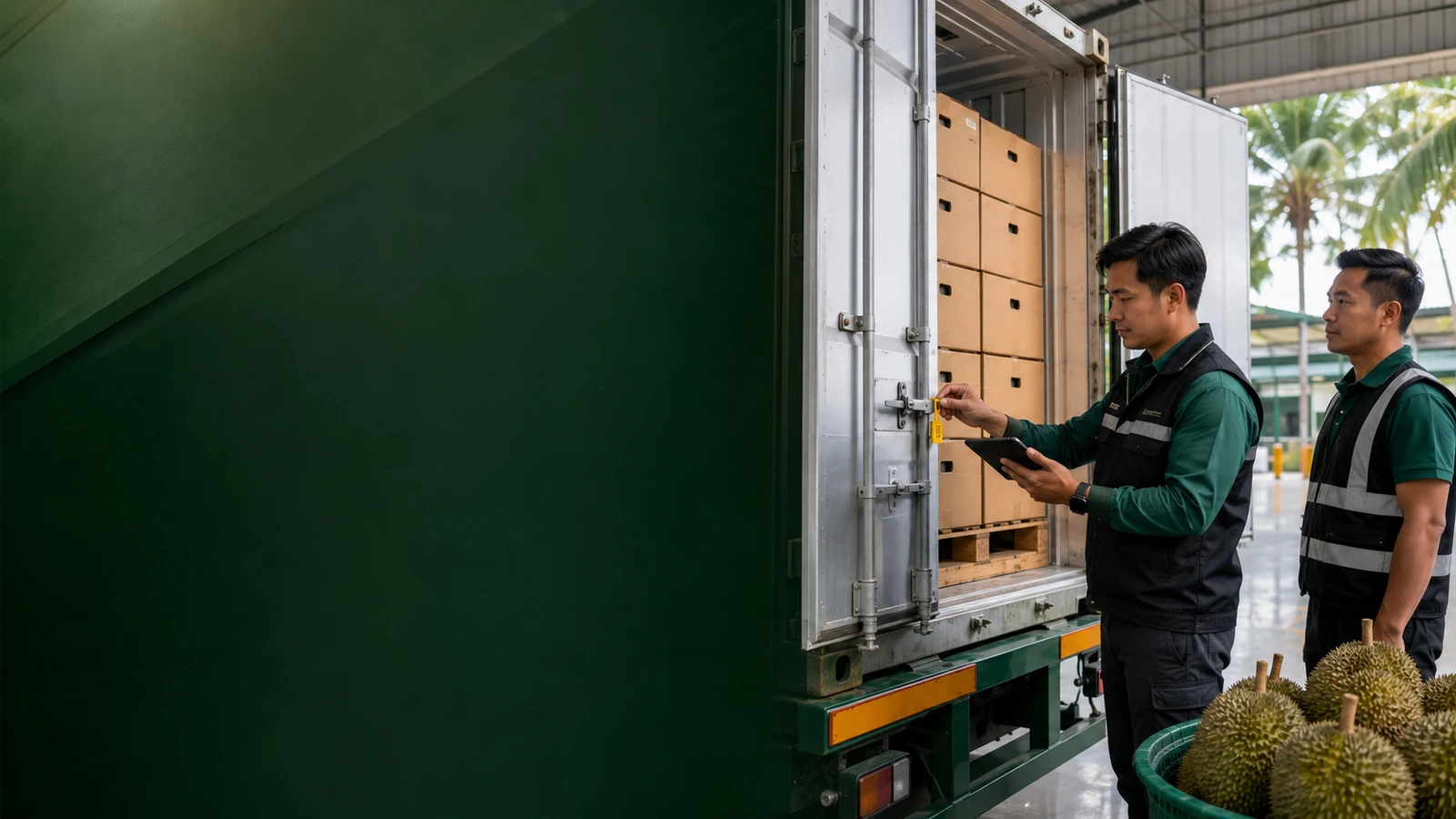
Durian container seals: keep seal numbers and documents aligned
A guide to controlling durian container seals: issuing seals, closing the container, photo evidence, matching the seal number to the SI and B/L, handling reseals and checking on arrival.
By the DurianTradeX team · Updated · Reading time 12 minPrimary keyword: durian container seal
- Short answer: control durian container seals as a chain of custody, not as a number you photograph at the end. Tie container number, seal number, shipment ID, who applied the seal, time, place and photo evidence into one record, then match it against the shipping instruction, draft B/L and gate-in data before the truck leaves.
- ISO 17712:2013 sets out how mechanical seals for freight containers are classified, accepted and withdrawn, but that doesn’t mean every shipment must always use the same seal type. Exporters need to check the instructions of the carrier, port, customs, destination country, sales contract and their insurance. The information here was checked on 31 August 2026.
- An intact seal helps show the doors weren’t opened without authorisation, but it does not confirm the quality, quantity or ripeness of the durian inside. It must work together with PTI, loading evidence, lot traceability, the temperature log and document control.
The answer first: make One Container, One Seal Record your control point
The costly mistakes rarely come from having no seal. They come from the real number and the document number being different, a reseal nobody reported, or no evidence of who applied the seal and when. The fix is one central record per container, so the packhouse, the truck, shipping and the document checker all read the same value, and nobody retypes the number across files by hand.
- Create the shipment ID before issuing the seal, then link the booking number and a container number with a verified check digit.
- Record the seal number once, by scan or single entry, with photos before use and after it is applied.
- Use maker and checker: the person applying the seal and the person confirming the number are different roles when the risk is high.
- Freeze the values when the truck leaves the packhouse; any change after that creates an exception event, never an overwrite.
- Match physical seal, shipment master and SI or draft B/L before gate-out and before approving the B/L.
- Keep evidence for as long as contracts, insurance and your data policy require; don’t set one blanket retention period.
A seal is a tamper indicator, not a product certificate
ISO describes mechanical seals as part of a security system for detecting whether container doors were accessed without authorisation. Don’t overstate it: a matching seal number doesn’t prove every durian meets spec, the weight is complete or the cold chain never broke.
High-security claims need evidence
If a contract or partner requires ISO 17712, ask the supplier for the product specification, classification and traceable evidence. Don’t judge by colour, size or the wording on the bag, and don’t treat the standard number as proof that a particular seal was never swapped.
Design the seal register from receipt to issue to disposal
A good seal register answers both quantity and accountability: which seal lot came in and how many, where it is stored, who issued it, which container it went on, how many are left, and how damaged, lost or cut seals were handled. If you only control the moment of sealing, you still leave room for duplicate numbers, seals off the books or seals used on the wrong shipment.
- Master data: manufacturer or supplier, model, type, serial range, lot or PO, date received and supporting documents.
- Status: Available, Reserved, Issued, Applied, Damaged, Lost, Cut/Destroyed and Quarantined.
- Access control: store in a restricted area, with a key holder or system and an entry log as appropriate.
- Issue control: issue against a shipment ID and container number; never hand seals out without a record.
- Sequence anomalies: alert on duplicates, out-of-range numbers, used numbers or unusual gaps, without automatically concluding fraud.
- Reconciliation: count stock against the system on a set cycle and after any anomaly, with a reviewer.
- Disposal: record damaged or cut seals, prevent reuse, and keep photos or witnesses according to risk.
Separate the seal owner from the shipment owner
The seal store keeper is responsible for inventory integrity. The shipment owner is responsible for choosing the number, applying it, matching documents and closing exceptions. Splitting the roles keeps the process auditable, so no single person controls everything from issue to approval.
A 10-step closing SOP from door check to truck departure
The IMO/ILO/UNECE CTU Code sets out duties to close the CTU properly, seal it when required and report the seal details to the parties concerned. Exporters should turn this into a repeatable dock SOP that doesn’t rely on staff memory.
- 1 Confirm shipment ID, booking, container number and container type against the job sheet.
- 2 Check doors, locking bars, gaskets, the seal point and any unusual marks before loading.
- 3 Close the loading record: lot, carton count, weight, stowage pattern and time loading finished.
- 4 Confirm people and equipment are out, doors are fully closed and the reefer setting matches the work order.
- 5 Check the seal before use: number readable, parts matching, undamaged and status available.
- 6 Apply the seal where the carrier or equipment guidance says, then pull-test the lock without damaging it.
- 7 Read the number aloud or scan it, and have the checker compare it character by character with the record.
- 8 Take a wide shot showing the container and door, a medium shot showing the position and a close-up showing the seal number.
- 9 Change the status to Applied and freeze the record; pass the value to the SI and draft B/L.
- 10 Do the final three-way match and record the driver, tractor and trailer, gate-out time and approver.
A close-up alone is not enough
A sharp photo of the seal number that doesn’t show which container it is on can get mixed up across shipments. Take shots at several distances or a short continuous video, and use file names or metadata tied to the shipment ID, without collecting more personal data than needed.
Never let AI create a number the photo didn’t capture
Only allow brightness adjustment or cropping of a copy to aid reading, and keep the original file and its history. If the number is unclear, retake the photo before the truck leaves. Don’t let AI fill in characters by guessing.
Lock 12 fields that must match before approving the SI and B/L
DCSA defines the seal number as the seal’s identifier, and the seal source as the party that applied it, such as carrier, shipper or customs. The B/L 3.0 process handles seal-number corrections through a shipping-instruction update, not by editing the draft transport document at will. Check the fields as a set and keep the version history.
- 1 Shipment ID
- 2 Booking No.
- 3 Container No. with check digit
- 4 Seal No., exact characters and dashes
- 5 Seal source, or who applied it
- 6 Seal type, or the requirement stated in the contract
- 7 Date and time applied, with time zone
- 8 Place applied, or packhouse
- 9 Person who applied it and the checker
- 10 Photo and video evidence and original files
- 11 The SI and draft B/L versions that reference this number
- 12 Exception and amendment status, and the approver
Use three freeze points
Freeze 1 after the container is closed, to stop edits on the dock. Freeze 2 after the SI is submitted, so any change must go through the amendment workflow. Freeze 3 after the B/L is approved, so a change becomes an event that needs coordination with the carrier, buyer and bank under the documents and contract.
The carrier portal is a destination, not the only master
Keep the number exported from your own system, with the submitted timestamp, sender, carrier reference and the verified or draft copy you received back. The portal may show the latest version but not the full change history your organisation needs for internal audit.
Use an exception playbook when a seal is wrong, broken or replaced
The key is to stop movement as far as is safe, preserve evidence, notify the people with authority, and record old seal, reason and new seal as one event. Never delete the old number and type the new one over it, because that breaks the chain of custody and leaves old values stuck in some documents.
- Wrong number before the truck leaves: hold, check the real container, correct the master through an approver, then send an SI update if the SI has already gone.
- Seal not properly locked: photograph it, quarantine the old seal, replace it per SOP and record the event.
- Seal broken or suspected opened in transit: stop at a safe place, don’t open the container yourself, and notify the control tower, carrier and insurer as planned.
- Customs or another authority opens the container: get the reference document, agency name, time, old seal, new seal and before-and-after photos where permitted.
- Terminal or carrier replaces the seal: ask for an official notice or equivalent evidence, then update the buyer and the affected documents.
- Number doesn’t match at destination: hold the opening where possible, invite witnesses, photograph the doors and seal, and run a joint inspection per the contract.
- Every time, assess the impact on the B/L, L/C, customs declaration, buyer acceptance, insurance and claim deadlines.
Don’t let staff conclude tampering on their own
A seal mismatch can come from a typing error, a reseal by an authority or unauthorised access. Record it as facts and a risk level first, then let the incident owner review the timeline and documents, without accusing anyone while the evidence is incomplete.
Build an evidence pack the destination and insurer can use
Seal evidence is valuable when it forms a timeline from packhouse to receiver, not scattered photos in a chat. Pack the data by shipment ID and assign an owner to every handover.
- Seal specification and a traceable purchase or receipt lot
- Seal register: issued, applied, replaced and destroyed, with who and when
- Photos and video of the doors, seal position, seal number, container number and surroundings
- Loading completion, PTI and reefer setting, temperature logger ID and gate-out record
- SI submission, draft and final B/L, amendment confirmation and gate-in or terminal receipt
- Inspection and reseal records from customs, the terminal, the carrier or other authorities
- Destination seal check before cutting, joint inspectors, opening time and receiving or QC report
- Incident communication, notice of loss, mitigation, survey and chain of custody for samples, if any
Set retention and access for the real case
Evidence may contain personal, travel and trade data, so use role-based access, download logs, a retention schedule and legal hold in line with contracts, insurance, law and company policy. Don’t share public links or keep files indefinitely without a reason.
Use AI and OCR to help check, not to create seal numbers
AI can read numbers from photos and compare many documents quickly, but seal characters often reflect light, sit at an angle or include confusable pairs like O/0, I/1 and B/8. The system must show the source image, the confidence and the differences so a person confirms before data goes out.
- OCR the seal number from the photo and compare it with the seal register, shipment master and draft B/L.
- Require an exact match after normalising only approved formats; never let AI guess characters it cannot see.
- Alert on duplicate numbers, numbers outside the serial range, numbers not in Available status or a missing seal source.
- Check that wide, medium and close-up photos are all present and that their times follow the sequence of events.
- Create an amendment task automatically when a new seal is recorded, without editing or submitting documents on its own.
- Require human approval before freezing, sending the SI, approving the B/L and closing an incident.
- Keep model version, input hash, extracted value, confidence, reviewer and final value as the audit trail.
KPIs to track
Track first-pass exact match, seal mismatches per 100 containers, duplicate and out-of-range alerts, evidence completeness, unauthorised reseals, time to reconcile, SI amendments after gate-out, destination exceptions and acceptance of claim evidence, split by packhouse, team, truck, carrier and route.
Next step: a container-level seal control board
DurianTradeX links container, seal register, lot, loading evidence, reefer data, SI and B/L, handovers and incidents on one shipment ID, with an exact-match gate, exception workflow and audit trail, so the team sees a wrong number before the truck reaches the port, not after the documents are issued.
A 30-day start plan that doesn’t wait for a big system
Start with one route and one packhouse, take a baseline, then expand. The goal is a single record you can trust and exceptions that are always closed, not the largest number of forms.
- Days 1–5: map receipt, storage, issue, application, SI submission, gate-in and destination, and name data owners.
- Days 6–10: set up the seal register, photo standard, three-way match and role and approval matrix.
- Days 11–15: trial 5–10 containers, recording errors and dock time without penalising people for pilot findings.
- Days 16–20: test a wrong number, a damaged seal, a customs inspection and a reseal after SI submission.
- Days 21–25: switch on OCR assist and duplicate alerts with human review, and measure false positives.
- Days 26–30: audit samples backwards, approve the SOP and retention, and set weekly KPIs.
- Before scaling: have the carrier, broker, buyer and legal or compliance review the requirements for real shipments, because this article does not replace their instructions or legal advice.
Release gates to enforce
The truck may leave when container, seal and shipment match and the evidence is complete. The SI may be sent when the checker approves. The draft B/L may be approved when it matches the post-gate-out values and every amendment is closed. If not, hold or raise an exception; never use a chat approval as the final evidence.
Frequently asked questions
Must every durian container use an ISO 17712 seal?
Don’t assume so. ISO 17712 is the mechanical seal standard used in international transport, but the actual requirement depends on the carrier, port, customs, destination country, contract, insurance or a partner’s security programme. Check the booking and SI instructions and the latest shipment requirements every time.
Does an intact seal mean the durian is complete and in good condition?
No. The seal helps show whether the doors were accessed, but it doesn’t prove quantity, weight, quality, ripeness or temperature. You need the loading record, lot traceability, QC and cold-chain evidence together.
Must the seal number appear on the B/L?
The seal number is data used in the transport process and in the DCSA B/L data model, but how and when it is shown and submitted depends on the carrier, route and documents. Check the shipping instruction and draft B/L for the actual shipment; don’t guess from earlier jobs.
If the seal number is wrong after the SI is sent, can we just fix our internal file?
No. Correct the master through an exception and approval, then send an SI update or amendment through the carrier’s process, and check the draft or final B/L and linked documents. Never overwrite the number without history.
What should we do when customs opens the container and replaces the seal?
Get the inspection reference, agency, time, old seal and new seal, with whatever evidence is permitted. Then update the chain of custody, the carrier, the buyer and the affected documents as required. Avoid applying a new seal yourself without a witness or authority.
Is a phone photo of the seal number enough evidence?
You should have a wide shot tied to the container, a position shot and a close-up where the number is readable, with time, inspector and the original file. Whether evidence is sufficient for a contract or insurer depends on their specific terms, not on the number of photos alone.
Can AI read seal numbers instead of people entirely?
Not yet. Light, angle and look-alike characters can make OCR wrong. Use AI to extract, compare and alert, but have a person view the original image and approve before freezing, sending the SI or approving the B/L.
Official sources
Information last checked on 31 August 2026
- ISO 17712:2013 — Freight containers — Mechanical sealsInternational Organization for Standardization · 2013 edition; checked 31 August 2026
- IMO/ILO/UNECE Code of Practice for Packing of Cargo Transport UnitsUNECE / IMO / ILO · January 2014; checked 31 August 2026
- CTU Code — Functions within the supply chainUNECE · Checked 31 August 2026
- Shipping Glossary — Seal, Seal number and Seal sourceDigital Container Shipping Association · Checked 31 August 2026
- Bill of Lading 3.0 — User stories for seal number amendmentsDigital Container Shipping Association · Checked 31 August 2026
- Container seals — numbered one-time door locksMaersk · Checked 31 August 2026
- How to Submit and Amend Shipping InstructionsMaersk · 17 January 2024; checked 31 August 2026
- Revised Kyoto Convention Guidelines — Customs ControlWorld Customs Organization · December 2010; checked 31 August 2026