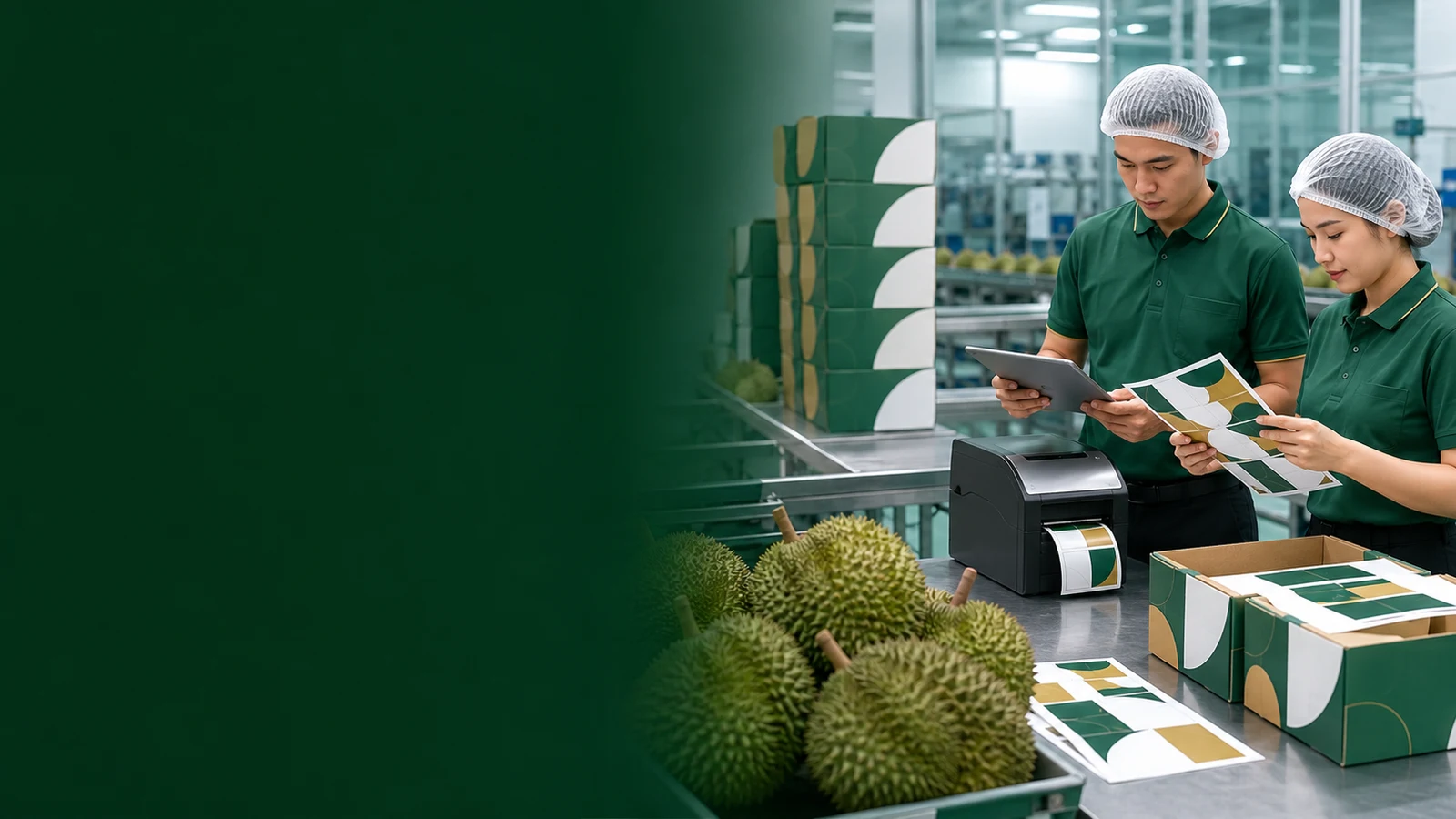
Durian carton labels for China: control 10 fields before printing
A guide to controlling durian carton labels for China, from GAP and DOA codes and packing dates to a label master, a four-way check, reprints, OCR and lot-level evidence.
By the DurianTradeX team · Updated · Reading time 12 minPrimary keyword: durian carton label China
- Short answer: create one label master per product, market, route and version, and pull orchard GAP, DOA packhouse, exporter and packing date straight from the shipment and lot master. Before printing, run a four-way check of the actual label against the carton, the lot record, the phytosanitary data and the commercial documents, quarantine old labels and control reprints.
- As checked on 1 September 2026: for fresh Thai fruit exported to China by land, the Department of Agriculture states that packaging must be new and clean and that labels must show the exporter’s company name, fruit name, orchard GAP registration number, DOA packhouse registration number, packing date and any wording required by the relevant notices. GACC sets the principle that cartons show the fruit name, origin and the names or registration numbers of the orchard and packhouse.
- The final label content can differ by transport route, border crossing, bilateral protocol, buyer and shipment documents, so confirm the latest instructions with the Department of Agriculture and the responsible agent for every trip. This guide separates official requirements from business controls so that internal lot numbers, line IDs or QR codes are not mistaken for Chinese legal requirements.
The answer first: make the label master the single source of truth before printing
Wrong labels usually come from copying an old file and changing only the date, or from receiving an orchard code in a chat and printing straight away. The controllable approach is a label master with a clear data owner, source, version and approval status, from which one print job is created per lot, so staff never edit artwork on the floor.
- Select market, transport mode, border or port, buyer and product specification before choosing a template.
- Use the exporter’s registered name, not a short name invented by marketing.
- Pick the orchard GAP and DOA packhouse from an approved master that shows status and date checked.
- Generate the packing date from the production event, not days in advance.
- Lock the required wording and language to the official instructions for that shipment.
- A maker prepares and a checker approves a real proof before the print job is released.
- Keep the approved PDF or artwork, version, hash, print quantity and who ordered the print in the audit trail.
A carton label is not a stem sticker
The Department of Agriculture also states that durian exporters must hold the relevant registrations and that every fruit must carry a stem sticker under the applicable notice. Carton labels, stem stickers and retail labels are separate controlled items even when they refer to the same lot. Do not merge their checklists so far that nobody can tell which item carries which data.
A QR code or barcode helps, but it is not an exemption from required text
You may use QR codes, GS1 barcodes or internal codes to scan lots, but do not assume a digital code can replace text the authorities require on the packaging unless the official instructions for that shipment clearly allow it.
Check these 10 fields on the label before it goes into use
These ten fields combine what official sources specify with internal controls that reduce mistakes. Fields 1–6 must follow the Department of Agriculture and GACC instructions that actually apply; fields 7–10 are business controls to use where appropriate, provided they do not conflict with the buyer’s specification.
- 1 — Exporter company name: matches the registration and the shipment documents.
- 2 — Fruit or product name: states durian and the product form required by the applicable instructions.
- 3 — Origin or place of production: uses the wording and language required at destination.
- 4 — Orchard GAP registration number: must be the real orchard for that carton or lot.
- 5 — DOA/GACC packhouse registration number: matches the actual packing site.
- 6 — Packing date: taken from the production record, in an unambiguous date format.
- 7 — Lot or batch ID: an internal traceability field, not claimed as a universal requirement.
- 8 — Product, grade and size: included when the contract or buyer requires it, and must match the packing list.
- 9 — Required wording and language: frozen by market, route and the latest notices.
- 10 — Label version and print job ID: internal control codes to recall labels of the wrong version.
When one container holds fruit from several orchards
Do not cover every carton with one main orchard code for convenience. Each carton must link to its real orchard and lot under the system the authorities accept. Separate pallets or zones, and scan samples after stacking to prove orchard codes have not crossed lots.
Names and registration numbers must not swap roles
Orchards and packhouses are different registered units. Keep a data dictionary with separate fields for orchard GAP, DOA/GACC packhouse, exporter registration and buyer code, rather than one “registration code” field for everything, or inspectors will not be able to tell which number means what.
Run a four-way match from the physical carton to the export documents
A correct proof on screen does not prove the label actually applied is correct. Sample cartons from the start, middle and end of each print job and from every lot, then check physical carton label ↔ production and lot record ↔ data for the PC/ePhyto ↔ invoice, packing list and shipment master before closing pallets and before loading.
- Physical: all text legible, not faded, not covered by tape and applied in a consistent position.
- Lot: orchard GAP, packhouse, packing date, variety or grade and carton count match actual production.
- Official documents: values given to officials or shown on the PC come from the same master.
- Commercial documents: product name, quantity, unit, marks and lot under the contract do not conflict.
- Shipment: container, booking, buyer, destination and label version belong to the right job.
- Evidence: photograph sample cartons together with the pallet or lot ID, without collecting more personal data than needed.
- Release: the checker signs only when there are zero differences or a written, approved deviation.
Set sampling by risk
Increase checks when the orchard, shift, ribbon or printer changes, when a reprint starts or after an error. Do not confirm every job with the same fixed sample size, and keep label sampling separate from the plan for checking fruit quality.
Control the print room, label stock and reprints so nothing gets mixed
The cost of a wrong label is not the paper. It is the relabelling, line stops, document corrections, missed cut-offs and questions at destination. Control files, templates, materials and label counts as you would any material that affects product release.
- Keep approved templates read-only and give edit rights only to the label owner.
- Each print job number links shipment, lot, template version, printer, time and operator.
- Check the first-off label before continuous printing and the last-off label before closing the job.
- Reconcile: printed = used + spoiled + remaining + destroyed, with any difference explained.
- Reprints require a reason, quantity and approver; never reprint from a file in Downloads.
- Cancelled and spoiled labels must be quarantined, marked and destroyed so they cannot be reused.
- When master data changes, assess work in progress, labelled cartons, closed pallets and goods already loaded.
Cartons pre-printed by a supplier also need version control
If the carton maker prints fixed information, send controlled artwork with the approved proof, purchase order and acceptance criteria, check samples before receiving, and quarantine old stock when a registration or wording changes.
Keep variable data off permanent printing plates
Orchard codes, packing dates, lots and other frequently changing data belong in a traceable variable-printing process. Printing them on large volumes of cartons in advance increases the risk of unusable stock or cartons used for the wrong lot.
Use an exception playbook when a wrong label is found
Do not peel or overprint straight away without a record: the team may fix only the cartons they can see while the master file and documents stay wrong. Each exception must state the scope, hold location, root cause, disposition and evidence that everything was checked before release.
- Before printing: reject the proof, correct the master through change control and issue a new version.
- During labelling: stop the machine, hold everything from the last good check to now and count what is affected.
- After pallets are closed: hold and segregate pallets, scan or open them under the risk plan, then reconcile labels.
- After loading: stop gate-out when it is safe to do so and assess unloading and the impact on cold chain and cut-off.
- After the PC or documents are filed: tell the responsible person immediately and correct through the authority’s process; never edit copies yourself.
- After the truck or container has left: open an incident with the broker, carrier and buyer and get instructions before relabelling or moving goods.
- In every case: keep original evidence and record old value, new value, reason and approver.
Never cover a label with a sticker without assessing it
A cover sticker may leave the original text readable, fall off in transit or conflict with buyer or authority requirements. Use an approved rework method, check adhesion and legibility, and complete a final verification once everything is corrected.
Use OCR and AI to check labels, never to create codes
Computer vision can read codes on cartons at several points, compare them with the approved master and flag swapped characters, wrong dates or faded labels. Shadows, creases, Thai–Chinese text and similar-looking codes cause false positives and negatives, so keep the original image, the confidence score and the human decision.
- The system pulls values from the approved master; the model never composes orchard or packhouse codes.
- Use exact matching for registration codes and dates; use fuzzy matching only to alert on names.
- Capture images with fixed lighting and distance, and apply an image-quality gate before OCR.
- Results below the confidence threshold go to a human review queue and are never auto-released.
- Mask unnecessary trading-partner data and control access to images and documents.
- Measure false accepts, false rejects, review time and mismatches caught before loading.
- Keep the model and version, prompt or rule set and any overrides for audit.
AI must never fill in characters on evidence images
If an image is unclear, take it again or open the real carton. Do not use generative AI to fill in missing characters: it destroys the value of the evidence and can create a code that never existed on the product.
Measure results and start a 30-day pilot
Start with one packhouse, one market and one carton format to prove that data flows from orchard to label without being copied again, then expand templates and routes. The aim is to catch errors before labels are used, not to add more forms.
- Days 1–5: map market and route requirements and assign a data owner for each field.
- Days 6–10: build the label master, approved list, print log and proof approval.
- Days 11–15: trial 3–5 lots with first-off and last-off checks, sampling and reconciliation.
- Days 16–20: test wrong orchard, wrong date, old template, duplicate print and reprint scenarios.
- Days 21–25: switch on OCR assistance while people still check in parallel, and collect an error set.
- Days 26–30: audit back from carton to orchard and PC, review the SOP and approve expansion.
- KPIs: first-pass approval, label mismatches per 10,000 cartons, reprint rate, unreconciled labels, hold minutes and exceptions found after loading.
- Business case: saved rework plus avoided delays and document amendments, minus system, labour, camera and printer costs, without claiming blanket loss figures.
Release gates worth enforcing
Print only when the proof and master are approved; close a pallet only when sample labels match the lot; load only when the four-way match passes; submit documents only when values from the shipment master match the labels actually used. Anything that fails goes to hold or exception, never to approval by a chat message that cannot be traced later.
Frequently asked questions
What must a durian carton label for China show?
For land exports, the Department of Agriculture lists the exporter’s company name, fruit name, orchard GAP registration number, DOA packhouse registration number, packing date and any wording required by relevant notices. GACC lists the fruit name, origin and the names or registration numbers of the orchard and packhouse. Check the latest instructions for the actual route, border and shipment before printing.
Can we use the main orchard’s GAP code for every orchard in a container?
No. The code on each carton must link to the real source under the lot and the system the authorities accept. With several orchards, separate lots or pallets and check that codes do not mix; never use a main code for convenience.
Is a packhouse’s DOA number always the same as its GACC number?
Do not assume they are the same. Store the field name, issuing authority, format and registration status separately, and use the value the official list and shipment instructions require.
Can a QR code replace text on the label?
Do not assume so. A QR code links data, but text the authorities or buyer require on the packaging must still appear unless official instructions for that shipment clearly say otherwise.
How many days ahead can the packing date be printed?
It should come from the actual packing event and the rules set by the authorities or buyer, not a fixed number of days. We recommend variable printing close to the production event and locking it after checking, so dates never mismatch the lot.
What should we do if a wrong label is found after loading?
Hold movement when it is safe, define the affected lots or pallets, keep evidence and have an incident owner assess unloading and the impact on cold chain, cut-off, the PC and documents before any rework. Never peel or cover labels without approval and a final verification.
Can AI replace the label checker completely?
Not yet. Use OCR and AI to extract, compare and alert, but registration codes need an exact match and uncertain results must be checked by a person against the original image and the real carton before release. AI must never generate a missing code.
Official sources
Information last checked on 1 September 2026
- Conditions for exporting fresh fruit from Thailand to China by land — label and packaging requirements (Thai)Department of Agriculture, Thailand · 1 December 2023; checked 1 September 2026
- Registration of orchards and packhouses and carton marking for fresh fruit imported into ChinaGeneral Administration of Customs of China (GACC) — Xi’an Customs · Checked 1 September 2026
- Registration of overseas orchards and packhouses exporting fruit to ChinaGeneral Administration of Customs of China (GACC) · 12 August 2026; checked 1 September 2026
- Registration and packaging marks for Thai fruitGACC — Haikou Customs · Checked 1 September 2026
- CXS 317-2014 Standard for Durian and CXC 44-1995 Packaging and TransportCodex Alimentarius Commission · Checked 1 September 2026
- GS1 Global Traceability StandardGS1 · Checked 1 September 2026